Indian Social Media- In a world increasingly dominated by a handful of global tech giants, the call for digital sovereignty has become a key strategic priority for nations. India, with its vast and dynamic youth population, is at the forefront of this movement. In his recent address on the 79th Independence Day from the Red Fort, Prime Minister Narendra Modi issued a powerful appeal to the nation’s young innovators: to develop indigenous social media platforms and other technological solutions to secure India’s digital future. This vision is not just about creating new apps; it’s about safeguarding national data, fostering economic value, and ensuring that India’s digital destiny is shaped by its own people.
The Imperative of Digital Sovereignty- Indian Social Media
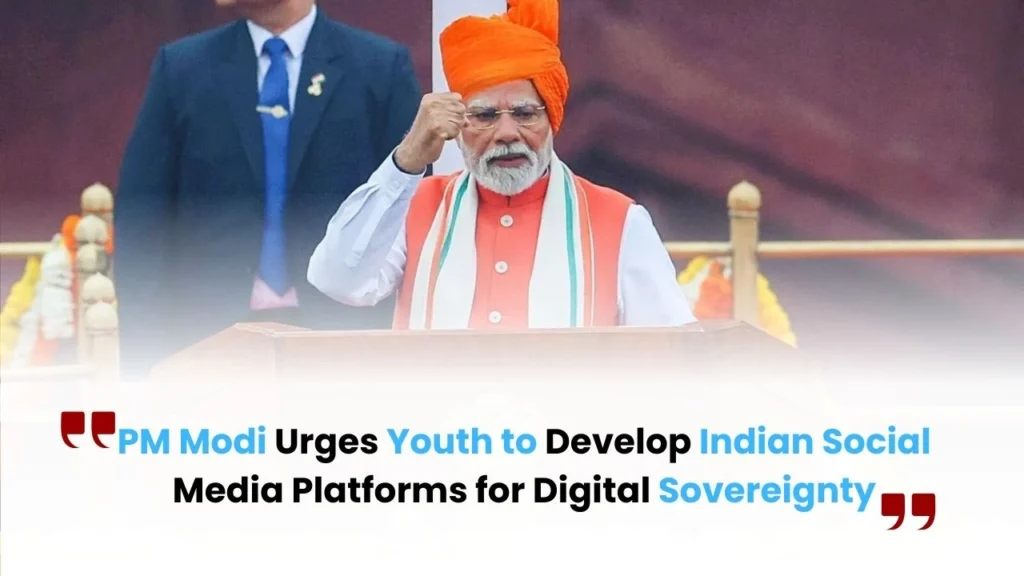
Digital sovereignty is the ability of a nation to govern and control its own digital ecosystem, including its data, infrastructure, and technology, in line with its laws and values. For India, this is a critical matter of national interest. The reliance on foreign-owned platforms for communication, commerce, and governance poses several risks, including:
- Data Vulnerability: Sensitive personal and national data residing on servers abroad is susceptible to foreign regulations and surveillance.
- Economic Leakage: A significant portion of the economic value generated from India’s digital users flows out of the country to multinational corporations.
- Algorithmic Bias: The opaque algorithms that govern content moderation and information dissemination on these platforms may not align with Indian cultural, social, and political contexts.
- Strategic Dependence: A nation dependent on foreign tech for critical infrastructure, from financial transactions (like UPI) to social networking, risks its strategic autonomy.
As PM Modi stated, “Why should we depend on others? Why should India’s wealth go out?” This rhetorical question underlines the economic and strategic rationale behind the push for ‘Made in India’ digital solutions.
The Blueprint for a Tech-Powered ‘Viksit Bharat’
The Prime Minister’s address was not just a challenge but an outline of a new ecosystem being built to support this ambition. He highlighted India’s progress in the semiconductor space, with the first ‘Made in India’ chips expected to be in the market by the end of 2025. This focus on foundational technology is crucial for achieving true digital independence.
The success of India’s Digital Public Infrastructure (DPI), such as the Unified Payments Interface (UPI) and Aadhaar, serves as a powerful precedent. UPI, for instance, now handles over 50% of the world’s real-time digital transactions, a testament to India’s capacity for creating large-scale, secure, and user-friendly digital platforms. This success story provides a roadmap for what is possible in the social media and creative domains.
Navigating the Challenges and Seizing the Opportunity
Creating successful homegrown social media platforms is a formidable challenge. The market is already dominated by global players with billions of users and immense resources. The journey requires more than just technical prowess; it demands a deep understanding of user behaviour, a robust business model, and the ability to build trust and community.
However, the opportunity is equally immense. India’s unique diversity, with its multitude of languages and cultures, presents a fertile ground for platforms that can cater to specific regional needs. Indian startups like ShareChat, Moj, and Koo have already demonstrated the potential of vernacular content and hyper-local communities.
The government’s role is to act as an enabler, providing policy support, simplified regulations, and a conducive environment for innovation. Initiatives like Startup India, which offer mentorship, funding, and regulatory relief, will be critical in nurturing the next generation of tech entrepreneurs.
The Road Ahead
PM Modi’s appeal is a clarion call to action for every young Indian with an innovative spirit. It is an invitation to participate in a nation-building exercise that will define India’s position in the 21st century’s digital order. By building our own platforms, we can ensure that our digital space reflects our own values, protects our data, and creates economic prosperity for our own people. The era of digital dependency is fading; the age of digital sovereignty is dawning, and its success hinges on the ingenuity of India’s youth.
ALSO READ
Why I Started RedPost – A New Indian Social Media Journey
India’s Deep Tech Ecosystem Gets $1 Billion Boost from New US-India VC Alliance