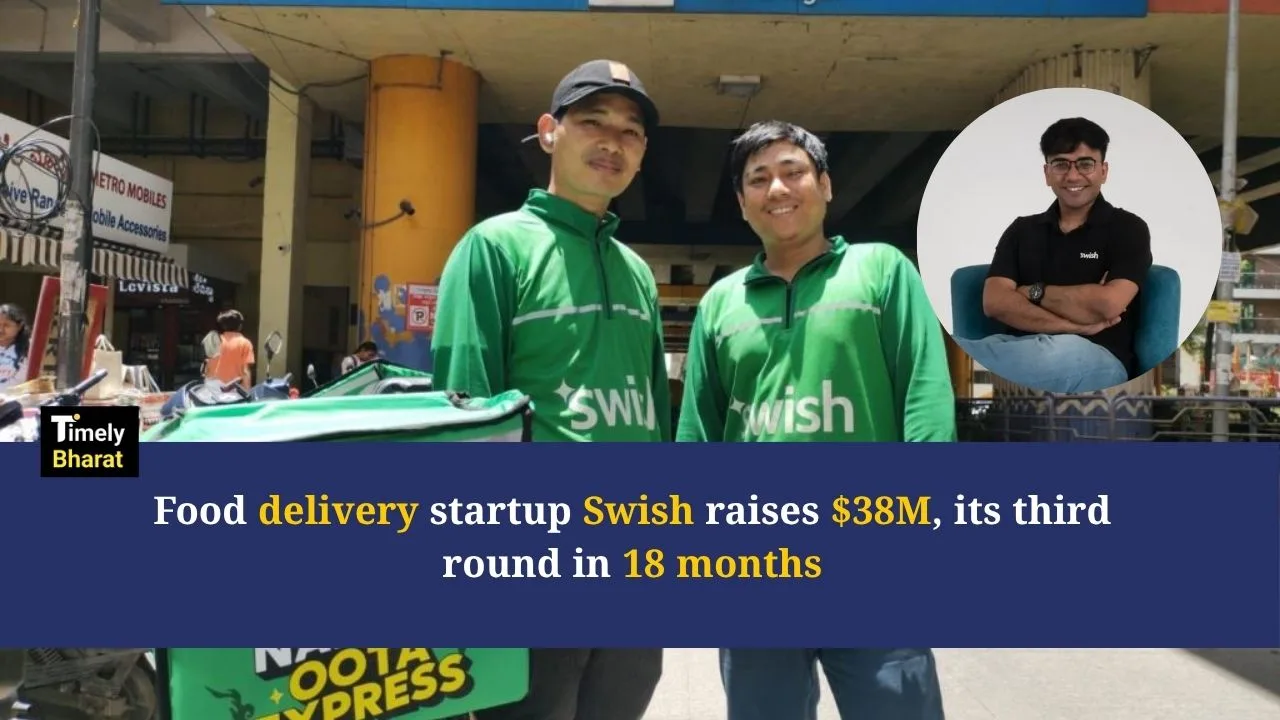
While industry giants like Swiggy and Zomato quietly scaled back their 10-minute hot food delivery ambitions, one Bengaluru startup is proving the model isn’t just viable—it’s aggressively scalable. Swish, a full-stack quick-service food delivery platform, has just secured a massive $38 million in Series B funding, propelling its valuation to $139 million. In a market where ultra-fast food delivery was largely dismissed as a logistical nightmare, Swish’s rapid ascent highlights a renewed investor appetite for bold, owned-infrastructure business models.
Here is how three founders in their mid-twenties built a hyperlocal empire that is fundamentally changing how urban India eats.
The $38 Million War Chest: Betting Big on Quick Commerce
Swish’s latest funding round marks its third successful capital raise in just 18 months, bringing its total funding to an impressive $54 million. This hyper-growth trajectory is a rare bright spot in the current Indian startup ecosystem.
The Series B round was co-led by Hara Global and Bain Capital Ventures, with strong participation from early backer Accel, alongside venture debt from Stride Ventures and Alteria Capital. This fresh capital infusion more than doubles the company’s previous valuation.
Where are the funds going?
- Geographic Expansion: Breaking out of its Bengaluru stronghold to enter high-density micro-markets in Delhi-NCR and Mumbai.
- Kitchen Automation: Upgrading proprietary backend technology to ensure standardized taste and faster cook times.
- Supply Chain Upgrades: Deepening their owned-logistics network to handle an increasing volume of daily orders.
The Full-Stack Playbook: Defying the Swiggy and Zomato Odds
Why did Swish succeed where giants struggled? The answer lies in their “full-stack” approach.
Marketplaces like Swiggy, Zomato, and Zepto primarily rely on third-party restaurants, making 10-minute delivery mathematically near-impossible due to unpredictable prep times and long rider commutes. Swish completely bypasses this bottleneck by operating exclusively within a hyper-dense 1-kilometer radius. They own the cloud kitchens, manage the supply chain, control the app interface, and deploy their own delivery fleet. By eliminating third-party restaurant commissions and standardizing prep via automated kitchens, older Swish clusters are already turning a profit.
“Owning every part of the food supply chain is the only way to serve high-quality, fresh food in 10 minutes at scale,” explains Swish CEO Aniket Shah.
Inside the Numbers: A Gen-Z Growth Story
Founded in early 2024 by Aniket Shah (an IIT Kharagpur graduate and former Meesho strategy lead), Ujjwal Sukheja, and Saran S., Swish was born from the ashes of the founders’ previous startup failure. Today, the numbers speak for themselves:
- Explosive Volume: The platform now delivers over 20,000 orders daily across 10 micro-markets in Bengaluru—a staggering 4x leap from just 5,000 orders four months ago.
- Menu Diversity: Offering over 200 items, the menu ranges from full meals and healthy bowls to quick snacks, beverages, and festive specials.
- Fierce Loyalty: Swish has cultivated a highly retentive user base of 20-to-35-year-olds. These super-users are ordering 10+ times a month, relying on the app not just for lunch or dinner, but for breakfast, tea-time cravings, and late-night binges.
- Healthy Economics: Despite the speed, the Average Order Value (AOV) sits comfortably between ₹200 and ₹250 ($2-$3).
Expanding the Market, Not Just Disrupting It
Investors are betting that Swish isn’t just stealing market share from existing food delivery apps; it is creating entirely new consumption habits.
Saanya Ojha from Bain Capital Ventures notes that Swish’s ability to seamlessly cater to micro-occasions—like a quick 4:00 PM snack or a rushed 8:00 AM breakfast—is actively “expanding the market.” Because the food arrives faster than a user could boil water and cook Maggi, convenience reaches an entirely new threshold.
Abhinav Chaturvedi from Accel echoed this sentiment, making a bold prediction: “Swish will define how a generation of Indians eats.”
The Road Ahead
As Swish prepares to export its 10-minute food delivery model to the notoriously chaotic streets of Mumbai and the sprawling neighborhoods of Delhi-NCR, the startup faces its biggest stress test yet. Scaling a hyper-local, operationally heavy business across diverse geographies will require flawless execution. But with a $38 million war chest, automated kitchens, and a business model that actually works on paper, Swish is no longer just an experiment—it’s a formidable challenger.
What’s your take? As quick-commerce platforms battle for your screen time, does the guarantee of piping hot food in exactly 10 minutes make you want to switch your primary delivery app? Let us know your thoughts in the comments below!
ALSO READ From Food Delivery to Brain Tech: Deepinder Goyal’s Neurotech Wearable ‘Temple’ Raises $54 Million
Meet Manas Ranjan Dash: How an Odisha Farmer Battled Spondylitis to Build a Mushroom Empire