Why Indians Shine in Global MNCs- India is the talent engine of the world. From Silicon Valley to Singapore, Indian-origin professionals lead global corporations as engineers, managers, and CEOs. Yet, despite this abundance of skill and ambition, India struggles to consistently produce startups that become global giants.
Why does this paradox exist?
The Stability vs. Risk Dilemma
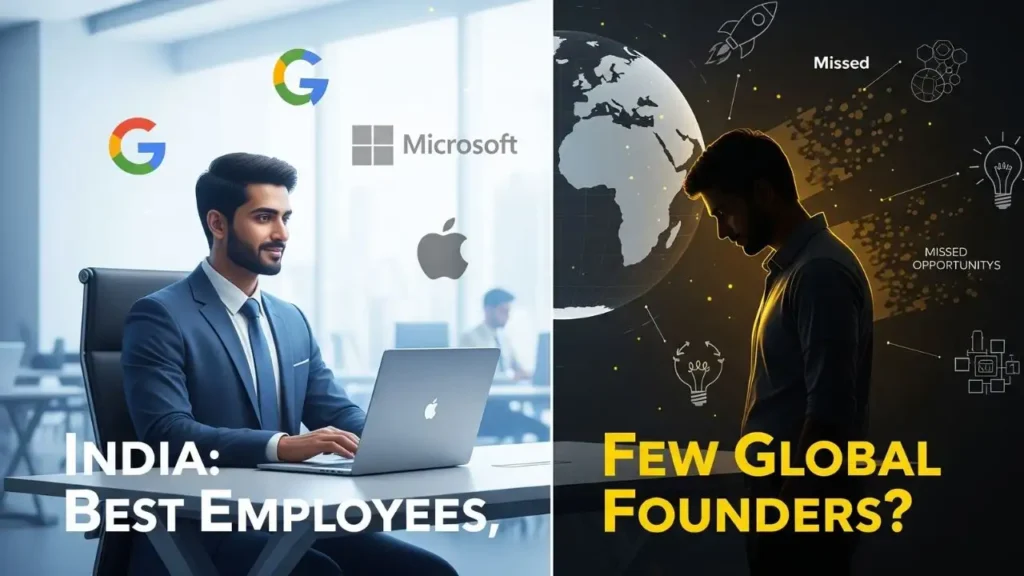
For decades, the Indian education and career system has prioritized security over risk.
- Rote Learning Culture – Schools emphasize memorization and problem-solving within defined boundaries. This sharpens execution skills but often limits creative, out-of-the-box thinking required for breakthrough innovation.
- Risk Aversion – A high-paying, stable job at Google or Microsoft seems far more attractive than the uncertainty of starting up. Social and family pressures tilt bright minds toward MNCs rather than risky ventures.
This has shaped generations of Indians into exceptional employees—perfectors and executors—but not always disruptors.
Funding Gaps: Quick Wins Over Deep Innovation
India’s startup ecosystem has grown rapidly, but funding patterns reveal a bias toward short-term gains.
- Flipping Culture – Many investors prefer quick-scaling business models (e-commerce, food delivery, fintech) that show fast returns.
- Neglect of Deep Tech – Areas like AI, biotech, semiconductors, and advanced robotics require heavy R&D and patient capital. Yet, a Nasscom 2023 report shows deep tech startups receive only a fraction of India’s total VC funding.
Without sustained investment, India struggles to create truly globally competitive technology companies.
Local Solutions, Global Limitations
Many Indian startups focus on solving India-specific challenges—digital payments, affordable mobility, or last-mile delivery. These are transformative domestically, but global expansion requires products designed for universal needs.
Airbnb and Uber didn’t just solve problems in San Francisco—they built solutions for the world. Indian entrepreneurs must similarly “think global from day one.”
Success Stories That Inspire
Despite hurdles, several companies show what’s possible:
- Zoho – A global SaaS powerhouse built from Chennai, competing with giants like Salesforce.
- UPI – A digital payments revolution in India, now inspiring adoption worldwide.
- Ultrahuman – A health-tech innovator bringing biohacking and fitness solutions to global users.
- Flipkart, Ola, and Zomato – Proved Indian startups can scale big, attract international investors, and even expand beyond borders.
These examples highlight India’s untapped potential.
The Path Forward: From Service to Self-Reliance
To consistently build world-leading startups, India must reshape its ecosystem:
- Foster Innovation in Education – Move beyond rote learning, encourage design thinking and product culture early.
- Support Deep Tech – Expand funding for high-risk, high-reward sectors with government–private collaboration.
- Simplify Regulations – Create smoother pathways for startup growth, exits, and foreign expansion.
- Strengthen R&D Infrastructure – Build world-class labs, incubators, and academia–industry partnerships.
- Think Global from Day One – Entrepreneurs must design solutions with scalability across borders.
Takeaway
Indian talent already powers the world’s greatest corporations. The challenge now is to channel that same brilliance into building companies that lead innovation globally, not just serve it.
The seeds have been sown—with Zoho, UPI, and Ultrahuman showing the way. If India embraces risk, long-term vision, and bold innovation, the next Google, Tesla, or SpaceX could very well be born in Bharat.
ALSO READ India’s Deep Tech Ecosystem Gets $1 Billion Boost from New US-India VC Alliance