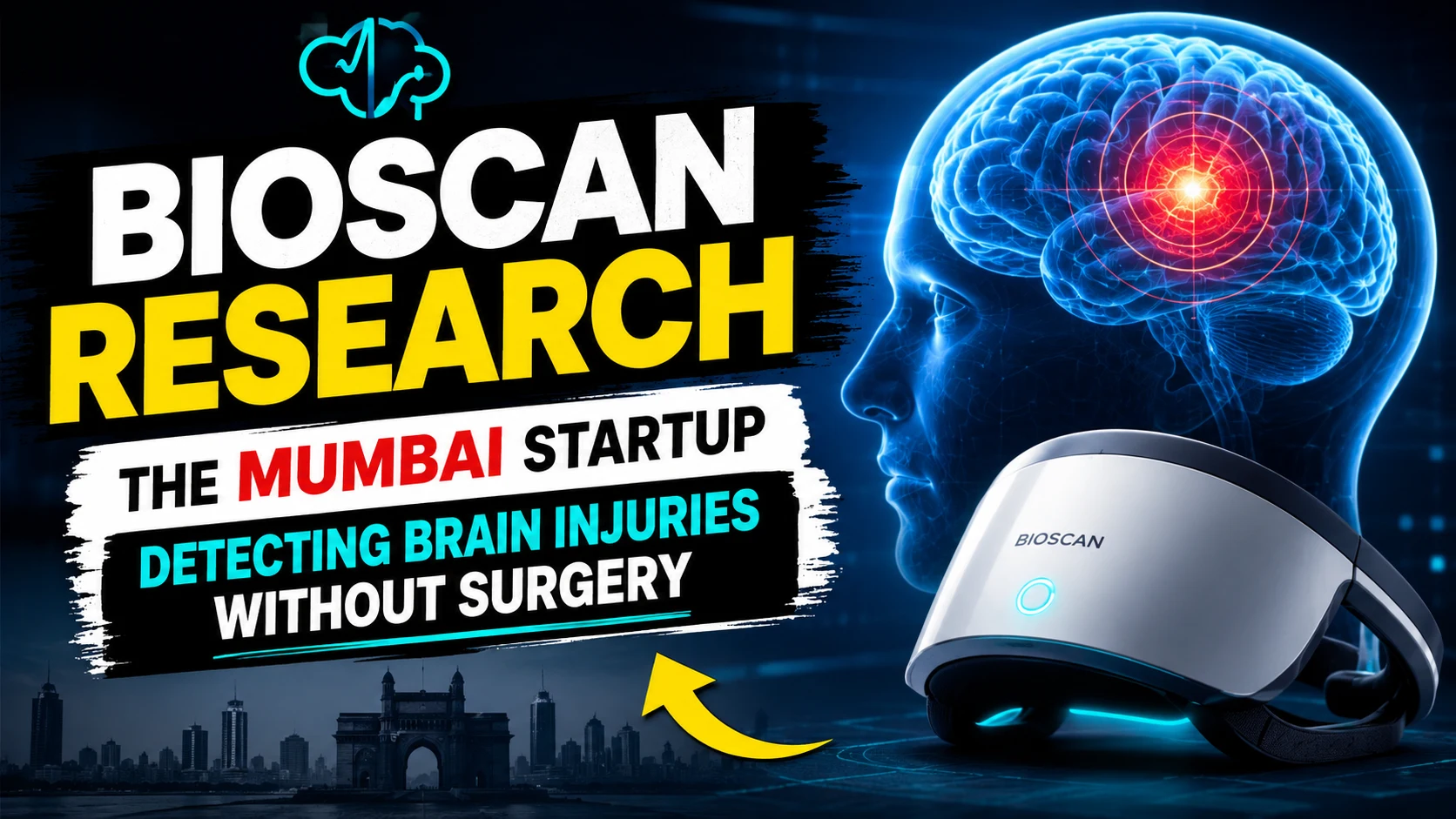
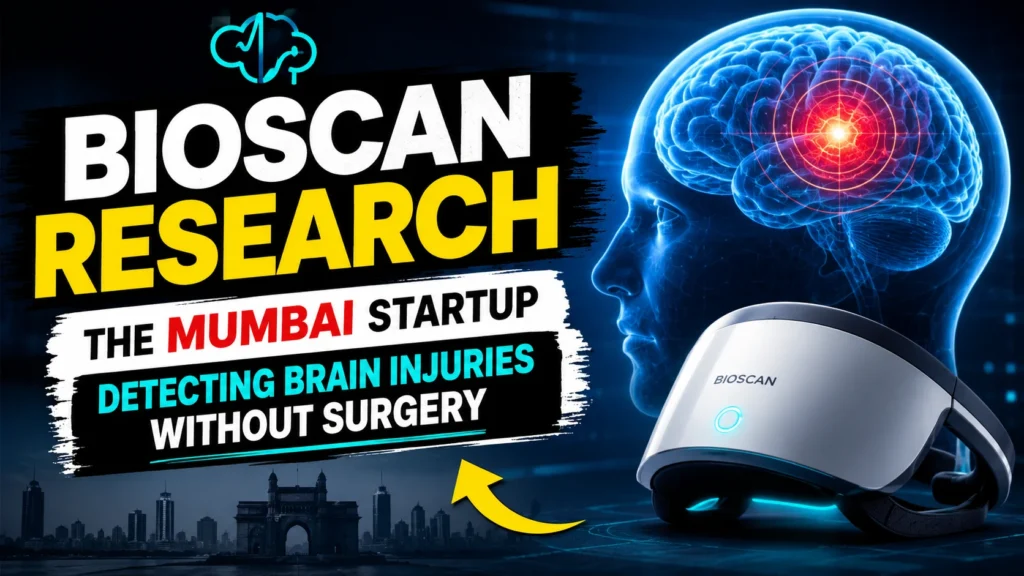
Every year, over 50 million people worldwide suffer from traumatic brain injuries (TBI). For many, the true danger lies not in the initial physical impact, but in the silent, hidden bleeding inside the skull that goes undetected until it is too late. Now, a pioneering Indian MedTech startup is fundamentally changing how we respond to head trauma—using light instead of radiation to save lives.
Founded in 2017 by Anupam Lavania and Shilpa Malik, Bioscan Research has developed a breakthrough solution to one of emergency medicine’s most persistent blind spots. Their flagship device, CEREBO®, is capable of detecting intracranial hemorrhages in less than two minutes without a single incision or a drop of harmful radiation.
The Silent Crisis of Traumatic Brain Injuries
In the realm of emergency and trauma care, the “golden hour” following an accident dictates the line between full recovery, severe long-term disability, or death. The most alarming challenge with mild traumatic brain injuries is that 50% to 90% of patients show no immediate visible symptoms. A person might walk away from a severe road traffic accident, a bad fall, or a sports collision feeling completely fine, only to collapse hours later from delayed internal bleeding.
Historically, confirming a brain bleed required rushing the patient to a hospital for a CT scan. However, traditional CT scanners are bulky, expensive, radiation-heavy, and rarely available at the site of an accident or in remote rural clinics. This logistical gap leads to missed diagnoses and delayed interventions. Bioscan Research aims to completely eliminate this bottleneck by bringing the diagnostic capability directly to the patient.
Harnessing Light and Machine Learning
To solve the accessibility problem, Bioscan Research engineered CEREBO® as a compact, battery-operated device that weighs just around 1 kilogram. Designed specifically for point-of-care usage, it can be seamlessly deployed across ambulances, sports fields, military base camps, and rural health centers.
The technology driving the device is a sophisticated blend of optical physics and artificial intelligence:
- Near-Infrared Spectroscopy (NIRS): Instead of utilizing X-rays, CEREBO® uses near-infrared light that safely penetrates the human scalp, skull, and cerebrospinal fluid. Because hemoglobin absorbs near-infrared light differently depending on its concentration, the device can detect the optical asymmetry caused by pooling blood inside the brain.
- Machine Learning Algorithms: The raw optical data is instantly processed by proprietary algorithms that determine the presence and probable location of an intracranial bleed (measuring hemorrhages greater than 2mL at a depth of 3-3.5 cm).
- Zero Radiation: Operating entirely on optical technology, the device is completely safe for repeated monitoring. It poses absolutely no risk to vulnerable populations, including infants, pregnant women, lactating mothers, or patients with magnetic implants.
Crucially, operating CEREBO® requires no specialized medical interpretation. A paramedic or trained first responder simply places the optical probes on the patient’s scalp—without needing to shave the hair—presses a trigger, and receives a definitive, easy-to-read result within seconds.
Clinical Validation and Investor Confidence
The medical and investment communities are rapidly recognizing the life-saving potential of this technology. Bioscan Research recently secured $1 million in a Seed funding round led by Unicorn India Ventures.
This fresh injection of capital is earmarked for aggressive expansion. The founders have stated that the funding will be utilized to strengthen their market presence, secure additional regulatory approvals, and further upgrade their product line. Having already recorded a remarkable fivefold growth over the past 12 months, the company is preparing to scale its affordable diagnostic tools from Indian clinics to a wider global market.
“We harness light to reveal what the eyes can’t see, giving doctors clarity, patients hope, and technology a heart,” co-founders Anupam Lavania and Shilpa Malik noted following the successful fundraise.
The device has also undergone rigorous clinical evaluation, with leading neurosurgeons in India acting as Principal Investigators to validate its accuracy across large sample sizes. It serves as a vital preliminary screening tool that helps doctors prioritize which patients urgently need further imaging, like a CT scan, within the critical 72-hour window post-injury.
Transforming the Future of Global Trauma Care
The implications of non-invasive, point-of-care neurodiagnostics stretch far beyond hospital walls. In the military, soldiers frequently suffer blast-induced concussions but lack immediate access to advanced neuroimaging in the field. In professional sports, quick and accurate sideline assessments can prevent athletes with undiagnosed hematomas from returning to the game and sustaining secondary impacts.
By democratizing access to brain injury diagnostics, Bioscan Research is proving that the future of medical technology isn’t just about building larger, more complex machines. It is about making critical care faster, safer, and portable enough to meet patients exactly where they are injured.
The Takeaway
Innovation in healthcare is most impactful when it bridges the gap between high-tech capability and on-the-ground accessibility. Bioscan Research is setting a new global standard for non-invasive diagnostics. If you are a policymaker, part of a healthcare facility, a sports academy, or an emergency response team, it is time to look beyond traditional imaging and advocate for point-of-care solutions like CEREBO®. Because when it comes to brain injuries, every single second counts.
Also Read Swish Lands $38M Series B: How a Bengaluru Startup is Winning the 10-Minute Food Delivery War