Imagine an employee who doesn’t just draft a response to a customer complaint, but actively investigates the root cause, processes a refund, updates the internal CRM, and emails a summary to the department manager—all without ever being prompted by a human.
This is no longer a sci-fi pitch or a boardroom pipe dream. Welcome to the era of Agentic AI.
For the past three years, the technology world was singularly obsessed with Generative AI—chatbots and copilots that acted as brilliant, yet inherently passive, digital assistants. But 2026 is officially marking a structural, irreversible shift in enterprise technology. We are moving from AI that simply talks to AI that independently does.
The Shift from “Assistants” to “Autonomous Doers”

To understand why 2026 is a watershed moment, one must understand the distinct line between Generative AI and Agentic AI.
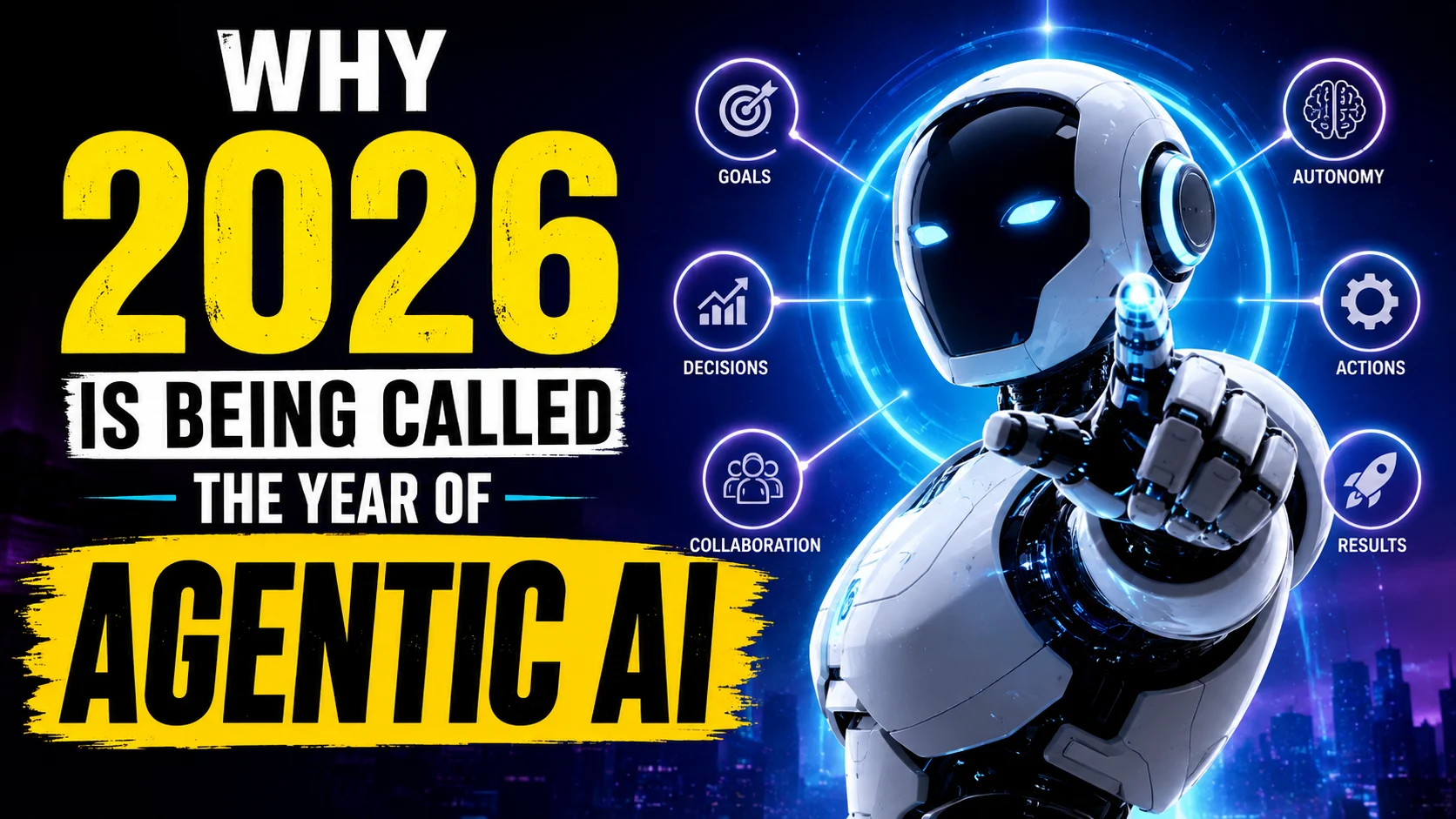
Traditional GenAI operates reactively: it waits for a human prompt, generates text or code, and stops. Agentic systems, however, are intrinsically goal-driven.When assigned an objective—such as “Resolve this supply chain bottleneck”—an autonomous AI agent breaks the problem down into sub-tasks.It interacts with multiple enterprise software systems, interprets changing environments, and course-corrects if it hits a roadblock, executing the workflow from start to finish with minimal supervision.
It does not wait for instructions; it anticipates, evaluates, and executes.
By the Numbers: The 2026 Tipping Point
Why is 2026 the breakout year? The industry data speaks volumes.
According to Gartner, 40% of enterprise applications will feature embedded, task-specific AI agents by the end of 2026. This represents a staggering leap from less than 5% in 2025. The global market for these autonomous AI agents is projected to surpass $10.8 billion this year, growing at a massive compound annual growth rate.
More importantly, adoption has rapidly transitioned from sandbox experiments to real-world deployment:
- Production Reality:An estimated 31% of enterprises now run at least one AI agent in production.
- Industry Leaders:The Banking, Financial Services, and Insurance (BFSI) sector is leading the charge, with nearly 47% adoption as agents manage heavy document reviews and compliance checks.
- The E-commerce Edge:Retailers running AI shopping agents are reporting up to a 20% increase in average order value, while autonomously handling 35–45% of complex post-purchase queries.
The Perfect Storm: Why Now?
The pivot to agentic autonomy didn’t happen overnight. It is the result of three converging factors maturing simultaneously this year:
- Economic Pressures and Tangible ROI:With inflation, tight margins, and hiring constraints, enterprises are demanding measurable returns on their AI investments. An agent that can autonomously execute a complex 45-minute workflow in seconds provides immediate, undeniable financial value.
- Architectural Maturity:Large Language Models (LLMs) have crossed a critical threshold where their reasoning and tool-use capabilities are genuinely reliable for production. Paired with advanced short- and long-term memory frameworks, agents can now retain context across days or weeks.
- The API-First Ecosystem: Agents need digital arms and legs to take action. The widespread adoption of API-first, cloud-native architectures allows AI to fetch real-time data from a legacy database, update an ERP system, and trigger communications instantly without human bottlenecks.
The Uncomfortable Truth for Enterprises
Despite the immense momentum, deploying Agentic AI is not simply a matter of buying a software license. It acts as a mirror, exposing a company’s deep architectural flaws.
For an AI agent to reason accurately, it must interpret an organization’s unstructured data—the millions of messy emails, PDFs, regulatory filings, and chat logs scattered across servers.If a company’s data is heavily siloed or its internal APIs are unreliable, autonomous decision-making breaks down instantly.
This structural reality brings a sobering warning from analysts: Gartner predicts that over 40% of agentic AI projects risk cancellation by the end of 2027 due to escalating costs, unclear value, and inadequate risk controls.Allowing an AI to independently read, write, and execute transactions requires a level of mature governance that only 21% of organizations currently possess.
The Takeaway: Evolve or Get Left Behind
The year 2026 will not just be remembered as the year artificial intelligence scaled; it will be recorded as the moment the business world was forced to rebuild its technology foundations for true autonomy. The modern CIO is no longer merely a custodian of IT infrastructure; they are now the architects of a digital, autonomous workforce.
Your Next Step: It is time to stop asking, “How can generative AI help my team write emails faster?” and start asking, “How must we architect our internal systems so autonomous AI agents can operate independently?”
The window to transition from rule-based scripts to goal-driven autonomy is narrowing fast. Those who act now will redefine operational excellence in their industries. Those who delay will find themselves competing against rivals who literally do business at the speed of thought.
Also Read How AI Is Quietly Running Your City’s Traffic Lights—And Saving You Hours of Commuting