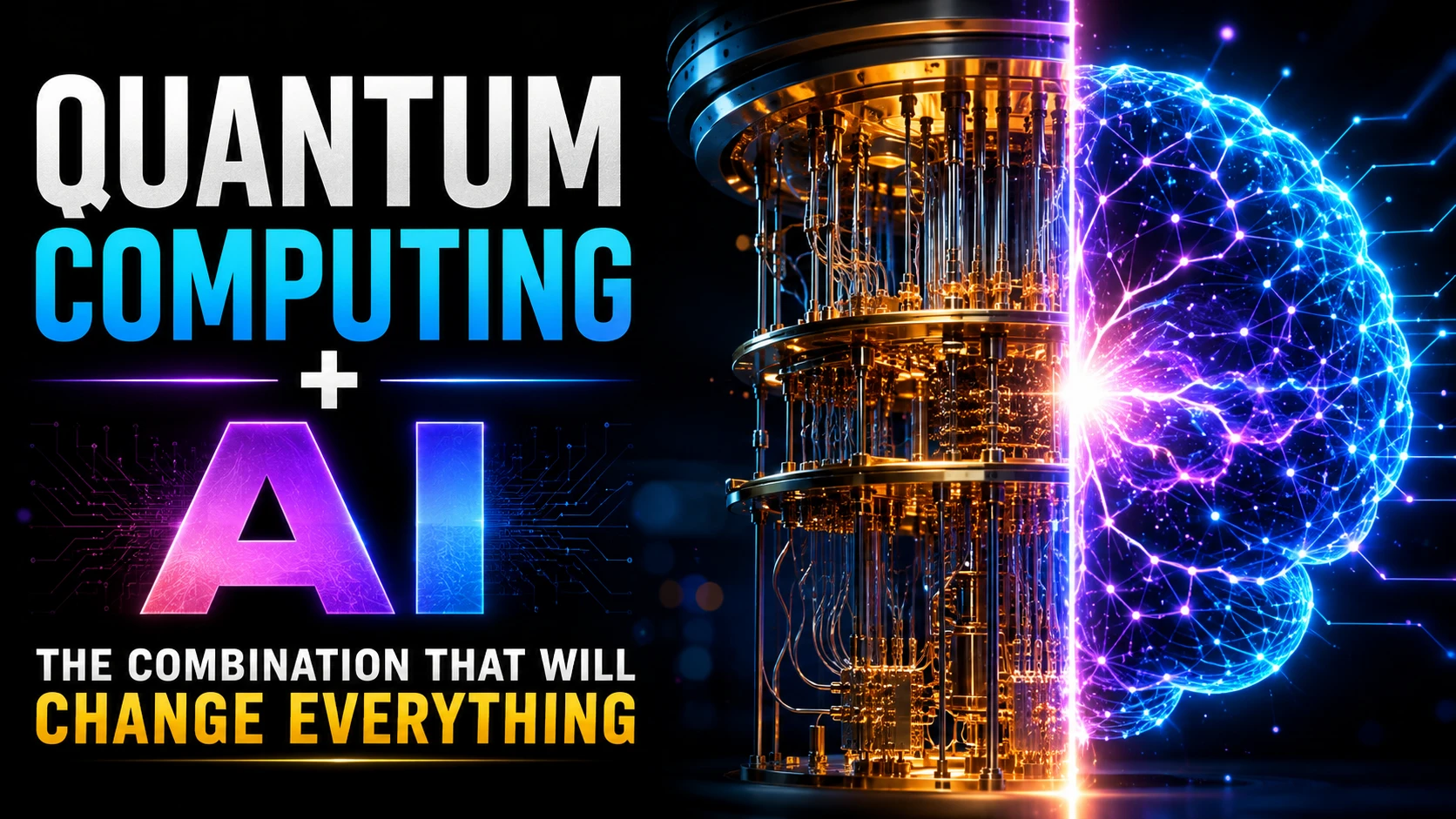
What would normally take today’s most advanced supercomputer 10 septillion years to calculate was recently completed in under five minutes. That is the sheer, mind-bending scale of quantum computing in 2026. But when you fuse this raw exponential computational power with the predictive brilliance of Artificial Intelligence (AI), it doesn’t just speed up data processing—it completely rewrites the rules of human innovation. We are no longer waiting for the future; the era of “Quantum AI” has arrived, and it is set to upend everything from life-saving medicines to global finance.
The Dawn of ‘Quantum Advantage’
For decades, quantum mechanics felt like high-level academic theory locked away in national laboratories. Not anymore. According to IBM’s 2025–2026 Quantum Readiness Index, the tech industry is rapidly approaching “quantum advantage”—the critical milestone where a quantum machine can solve specific, high-value problems cheaper, faster, and more accurately than any classical system.
Recent hardware leaps have shattered previous timelines:
- Google’s Willow Chip:Completed complex benchmark calculations in mere minutes, demonstrating an exponential reduction in error rates as more qubits were added—previously the industry’s biggest roadblock.
- Microsoft’s Majorana 2:Launched in mid-2026, this chip introduced topological qubits that improved system stability 1,000-fold over previous generations.
- IBM’s Nighthawk:A 120-qubit processor cementing a clear, aggressive roadmap toward fully fault-tolerant quantum systems by the end of the decade.
These are not science fiction prototypes; they are billion-dollar infrastructure milestones. The quantum computing market crossed the $1 billion revenue mark in 2025, and firms like McKinsey now project it will unleash between $1.3 trillion and $2.7 trillion in global economic value by 2035.
How AI and Quantum Computing Amplify Each Other
Why combine AI and quantum? Think of it this way: AI is incredibly smart at finding patterns in massive datasets, but classical computers eventually hit a hard wall when processing highly complex, multi-variable environments, like simulating the exact molecular structure of a new chemical.
Quantum computing steps in as the ultimate accelerator. While classical computers process data in binary bits (0s and 1s), quantum computers use “qubits,” which can exist as both 0 and 1 simultaneously thanks to a principle called superposition.
Through Quantum Machine Learning (QML), quantum computers can generate perfect simulations of physical reality at a subatomic level. AI models are then trained on this hyper-accurate quantum data, making leaps in reasoning and generative modeling that classical AI simply cannot match. In fact, IBM reports that positioning quantum as complementary to AI unlocks a 33% higher investment return for forward-thinking enterprises.
Real-World Applications Already in Motion
The fusion of Quantum Computing and AI is not about building a better smartphone or a faster web browser. It is strictly about tackling existential, civilization-level challenges.
- Revolutionizing Drug Discovery: Today, bringing a new drug to market takes over a decade and costs billions of dollars. Quantum AI changes this by simulating how a drug molecule interacts with a protein in the human body at the quantum level. By analyzing these intricate interactions, AI can predict the efficacy and toxicity of new chemical compounds in a matter of days. This means faster cures for complex diseases and highly personalized medicine.
- Solving the Climate Crisis: To transition away from fossil fuels, the world desperately needs better batteries and novel carbon-capture materials. Quantum AI is being deployed to model climate systems with unprecedented, hyper-local accuracy and to discover synthetic materials that can store renewable energy far more efficiently than today’s lithium-ion technology.
- Transforming Global Finance: Wall Street hedge funds and major international banks are already exploring quantum algorithms for high-frequency trading, real-time risk assessment, and fraud detection. Quantum models excel at identifying market anomalies and complex time-series patterns exponentially faster than traditional financial algorithms.
The Cost of Waiting: Why Businesses Are Scrambling
In the fast-paced tech world, arriving late often means becoming obsolete. The “quantum-ready” organizations of 2026 are already pulling away from the pack. According to recent surveys, companies actively integrating quantum capabilities into their workflows expect up to 53% more Return on Investment (ROI) by 2030 compared to their competitors who are merely watching from the sidelines.
Yet, capitalizing on this revolution is not easy. There is a dangerous, widening talent gap. Over 60% of companies cite inadequate quantum skills as their primary barrier to entry. The combination of quantum physics, advanced mathematics, and machine learning requires an entirely new breed of interdisciplinary talent that universities are racing to produce.
The Bottom Line
The convergence of Artificial Intelligence and Quantum Computing is the most significant technological paradigm shift since the invention of the internet. We are steadily moving from a world of AI that merely guesses and estimates based on past data, to a Quantum AI ecosystem that mathematically understands and creates native solutions to nature’s toughest puzzles.
The Takeaway: The quantum revolution will not announce itself with a single, dramatic flash; it is already rippling through global R&D departments and corporate boardrooms. For business leaders, policymakers, and tech enthusiasts, the mandate is clear: start building your quantum literacy today. Do not wait for the technology to mature perfectly before you engage. By the time quantum computing becomes an everyday enterprise tool, the early adopters will have already rewritten the future. Prepare now, or prepare to be left behind.
Also Read How AI Is Quietly Running Your City’s Traffic Lights—And Saving You Hours of Commuting