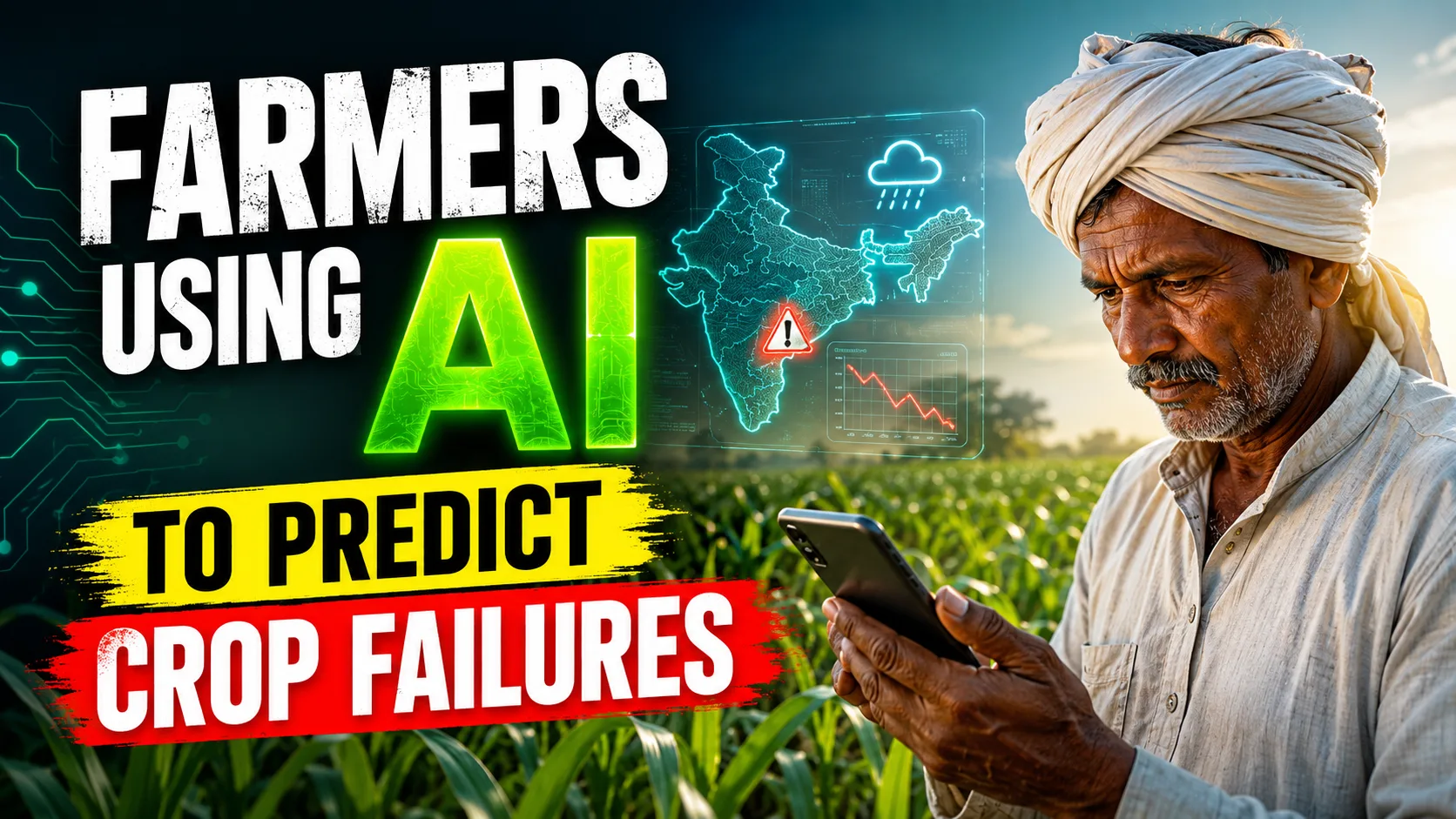
“Are my crops doing well?” is a question that has plagued generations of Indian farmers, often answered too late by the devastating sight of a ruined harvest. But today, the answer isn’t left to the whims of the skies or the soil—it’s arriving via localized SMS alerts and multilingual smartphone apps. Across the country’s vast agricultural heartland, artificial intelligence (AI) is stepping out of the tech parks and into the mud, helping millions of farmers predict crop failures before they happen and optimize their yields against the growing threat of climate change.
The End of Guesswork: Sowing by the Data
For decades, sowing decisions in India were dictated by traditional almanacs and the unpredictable arrival of the monsoon. A miscalculation of even a few weeks could result in total crop failure due to inadequate soil moisture or sudden dry spells.
To combat this, the International Crops Research Institute for the Semi-Arid Tropics (ICRISAT) partnered with Microsoft to develop an AI Sowing App.The beauty of this system lies in its accessibility: farmers don’t need to invest in expensive hardware or internet data plans.Instead, the AI calculates the Moisture Adequacy Index (MAI)—a metric that measures rainfall and soil moisture—and sends a simple text message in the local language advising the farmer on the exact optimal date to sow their seeds.
By analyzing historical climate data and real-time weather patterns, the technology eliminates the guesswork. Recent data highlights that AI-based local monsoon forecasting initiatives have reached nearly 3.88 crore (38.8 million) farmers across 13 states, with a significant percentage altering their land preparation based solely on algorithmic predictions.
Diagnosing Diseases with a Simple Click
The United Nations Food and Agriculture Organization estimates that plant diseases and pests destroy up to 40% of global crop yields annually. In India, a delayed diagnosis often means the difference between a profitable season and crushing debt.
Enter Plantix, a mobile application that turns a standard smartphone camera into a pocket-sized agricultural scientist.Built by a Berlin-based startup in collaboration with ICRISAT, the app uses machine learning to diagnose crop damage.
Here is how the system is currently transforming on-the-ground pest management:
- Instant Diagnosis:A farmer snaps a photo of an affected leaf, and the AI matches it against a database of over 500 crop diseases, boasting an 85% accuracy rate.
- Crowdsourced Intelligence: The algorithm is constantly trained on thousands of new images submitted daily, getting smarter with every photo uploaded.
- Actionable Solutions: It doesn’t just identify the pest; it recommends precise, scientifically verified remedies, empowering farmers who are often misled by local chemical traders.
Currently used by tens of thousands of Indian farmers daily, the app focuses heavily on staple crops like groundnuts, rice, wheat, and tomatoes, acting as a crucial first line of defense against widespread crop failure.
Precision Farming That Actually Pays Off
The perception that precision farming in India is a luxury reserved for massive corporate farms is rapidly changing, thanks to indigenous agritech startups.
Consider the case of a localized precision farming system developed by the Tamil Nadu-based startup, Farm Again.By deploying affordable, solar-powered sensors—costing roughly a tenth of imported alternatives—the system monitors soil moisture, irrigation needs, and fertilizer levels in real time.
The results have been transformative:
- Yield Increases:Farmers utilizing this AI-enabled monitoring have seen coconut yields double.
- Resource Optimization:The system automatically cuts off irrigation when optimal moisture is reached, averting root rot and conserving over 4,00,000 cubic meters of water annually.
- Mass Adoption:Driven by affordability, this exact approach has already benefited over 3,500 farmers across 4,000 acres in Tamil Nadu alone.
At a macro level, government reports show that AI-enabled agricultural networks have improved price discovery and logistical efficiency for about 1.8 million farmers across a dozen states.
The Road Ahead: Democratizing AI for the Marginal Farmer
The integration of AI in Indian agriculture is no longer a futuristic concept; it is a vital survival tool. As climate change continues to disrupt traditional farming cycles, AI’s ability to process massive datasets—from satellite imagery to IoT soil sensors—will be the key to ensuring food security.
However, the technology will only fulfill its true potential if it remains affordable and accessible. The success of simple SMS advisories and free diagnostic apps proves that the most sophisticated algorithms are useless if they cannot reach the marginal farmer standing in a remote, low-bandwidth field.
The Bottom Line: The future of Indian agriculture depends not just on building smarter AI, but on building AI that speaks the farmer’s language. Agritech startups and policymakers must continue to prioritize low-cost, mobile-first solutions. If we can democratize this data, we won’t just be predicting crop failures—we will be preventing them entirely.
Also Read The Hidden AI Settings on Your iPhone You Should Turn On Today