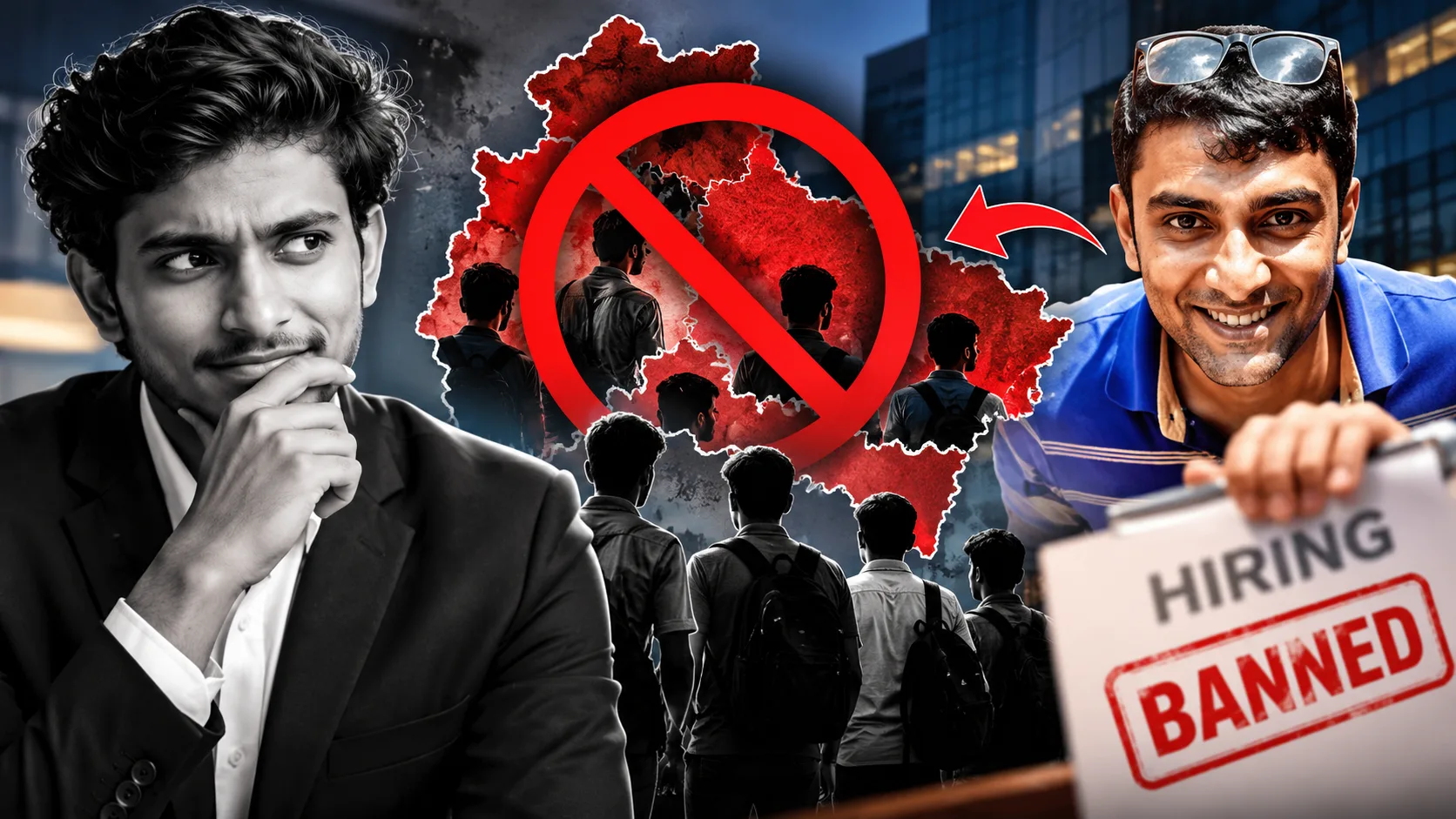
A Bengaluru entrepreneur’s decision to stop hiring male candidates from Uttar Pradesh, Bihar, Rajasthan and Madhya Pradesh has triggered a wider debate about workplace safety, regional bias and how companies should respond when an employee allegedly crosses the line.
Now, Neftic founder Shivam Namdeo has entered the conversation, arguing that protecting employees is essential — but that an individual incident should not automatically become a reason to exclude thousands of unrelated candidates based on their place of origin.
Bengaluru CEO’s hiring decision sparks controversy
Karthik SG, founder of Bengaluru-based A1 Sports World, announced on September 22 that his company would no longer hire male candidates from four states: Uttar Pradesh, Rajasthan, Bihar and Madhya Pradesh. He said the decision followed an internal discussion after an incident involving a former employee.
The entrepreneur later said the employee had allegedly behaved abusively towards female colleagues despite receiving two warnings and had allegedly attempted to force himself on a female employee.
Karthik said the employee was an MBA graduate whose résumé and background had appeared clean during recruitment. According to his account, the alleged behaviour emerged around two months after the employee joined the company.
Those allegations have not been independently established in the reports reviewed for this article.
Karthik also said A1 Sports World has 32 employees, including 14 women, and that 20 employees are from outside Karnataka, including 12 from outside South India. He said workplace and child safety were central to his decision.
When criticised online, he defended his position with the statement: “My company, my rules.”
Shivam Namdeo questions the logic of collective exclusion
Responding to the controversy, Neftic founder Shivam Namdeo has challenged the idea that an individual employee’s alleged misconduct should translate into a geographical hiring restriction.
His argument is straightforward: if the problem was one employee, the appropriate management question should be what happened during the recruitment and probation process — and what systems can prevent a similar incident in the future.
“Your personal experience cannot automatically become company policy,” Namdeo argues.
He points instead to mechanisms such as:
- Better background and reference checks
- More structured interviews
- Stronger probation processes
- Clear workplace conduct policies
- Proper complaint and escalation mechanisms
- Individual accountability for misconduct
The central distinction, according to Namdeo, is between managing an incident and generalising from it.
“If one person creates a serious problem, my first question as a founder would be: ‘What did we miss, and how do we build a better system so this doesn’t happen again?’”
The problem with using geography as a hiring filter
Namdeo’s criticism focuses on the gap between evaluating an individual and evaluating an entire category of people.
A candidate from Indore, Patna, Lucknow or Jaipur does not necessarily share the behaviour, values or workplace conduct of another person who happens to come from the same state.
That makes state of origin a weak substitute for evaluating the qualities employers actually need to assess: professional conduct, qualifications, references, communication, experience and behaviour during the hiring process.
The controversy therefore raises a broader question for Indian startups: Can a company legitimately prioritise workplace safety while still ensuring that hiring decisions are based on individual candidates rather than broad demographic assumptions?
The two objectives are not necessarily incompatible.
Bengaluru’s identity is deeply connected to migration
The Bengaluru dimension adds another layer to the debate.
Official Census of India datasets track migration into Karnataka and Bengaluru by place of previous residence, duration and reason for migration.
Research based on Census 2011 data has estimated that migrants accounted for around 50.6% of Bengaluru’s population, placing the city among India’s major destinations for internal migration. Employment has been identified as one of the principal reasons for migration to the city.
That does not mean Bengaluru’s growth can be attributed to migrants alone. Karnataka’s own population, institutions, entrepreneurs and workforce have been fundamental to the city’s development.
But it does underline an important reality: Bengaluru has developed as a labour and talent magnet for people from across India.
For companies operating in that ecosystem, birthplace can therefore be a particularly blunt hiring filter.
A founder-to-founder disagreement
Namdeo has also made clear that his response is not an argument against workplace safety or zero tolerance for harassment.
His position is that companies should act decisively against individuals accused or found responsible for misconduct while simultaneously improving the systems that allowed the problem to emerge.
That distinction matters.
A company has the right to establish workplace standards and take action when those standards are breached. But whether a broad geographical restriction is an effective way to achieve that objective remains a separate question.
The controversy has consequently moved beyond one founder’s hiring policy. It has become a discussion about how Indian startups handle risk, recruitment, workplace safety and regional diversity.
The larger lesson for founders
The debate ultimately presents two competing instincts after a serious workplace incident.
One is to reduce risk by excluding a broader category of candidates.
The other is to improve the process so that individuals are evaluated more effectively.
Namdeo’s response argues for the second approach.
His message to founders is blunt: protecting employees is part of leadership, but so is ensuring that one person’s alleged actions do not become the basis for judging thousands of people who have never been given an opportunity.
As he puts it: “My state isn’t your hiring problem. Your hiring process is.”
For Indian startups hiring in increasingly diverse cities such as Bengaluru, the question may not be whether founders should have rules. It is whether those rules actually address the problem they were created to solve.
ALSO READ
Quantum Computing + AI: The Combination That Will Change Everything