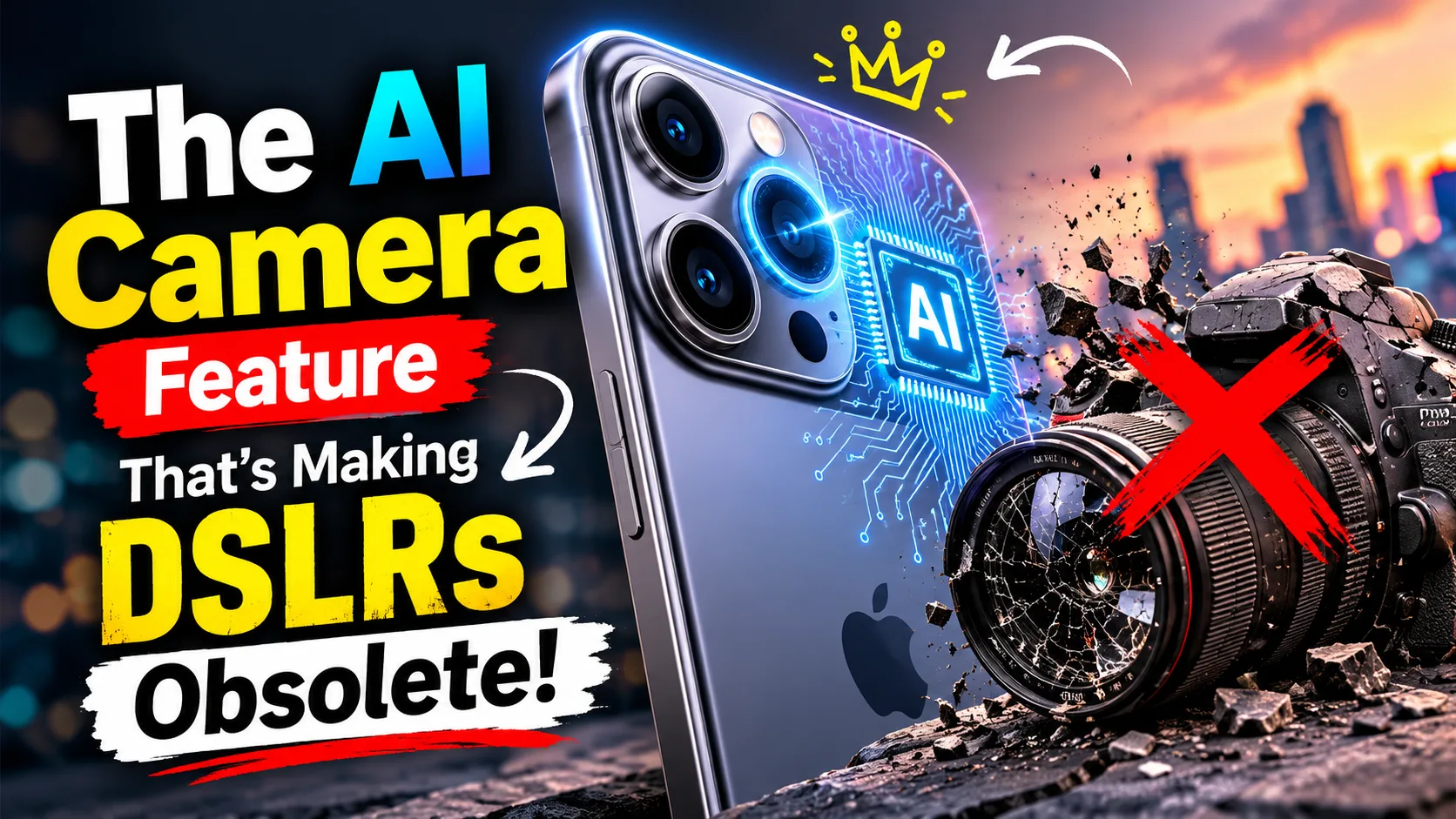
You pull out your smartphone in a dimly lit restaurant, tap the shutter once, and capture a portrait that looks like it was shot on a $3,000 professional camera rig. There is no bulky lens, no manual aperture ring, and no blinding flash—just billions of calculations happening in a fraction of a second. For decades, the heavy Digital Single-Lens Reflex (DSLR) camera was the undisputed king of high-quality photography. Today, a quiet revolution in artificial intelligence is officially making it a relic of the past for all but the most specialized professionals.
The secret isn’t just more megapixels; it is the breathtaking leap in computational photography and AI-driven image processing.
The Physics Problem vs. The AI Solution
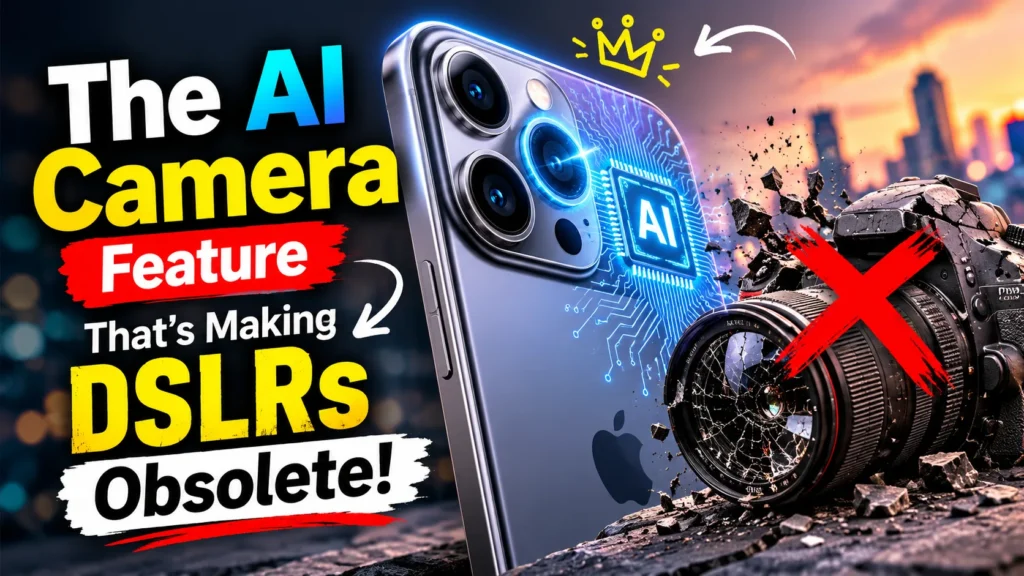
To understand why smartphones are winning, you have to understand the battle between physics and software. Traditional cameras have always won on pure physics. A full-frame mirrorless or DSLR camera sensor boasts a massive surface area, allowing individual pixels to capture nearly 18 times more light than a standard smartphone sensor.
Historically, this massive “light bucket” allowed professional cameras to create a natural depth of field (that beautiful blurred background, or bokeh) and capture clean, noise-free images in low light. A smartphone simply cannot physically fit a massive glass lens and a large sensor into an 8-millimeter-thick aluminum frame.
But where hardware hits a wall, artificial intelligence builds a bridge. Rather than relying solely on pure optics, modern flagship phones use dedicated Neural Processing Units (NPUs) to rebuild the image, pixel by pixel.
The Game Changer: Semantic Segmentation
The biggest nail in the DSLR’s coffin is a breakthrough software technique called semantic segmentation. In the past, a camera would evaluate a scene and apply a single, global exposure setting. If the sky was bright, the faces in the shadows went dark.
With semantic segmentation, powered by advanced 2026 chipsets like the Snapdragon 8 Elite Gen 5 and Google’s custom Tensor G5, the camera’s AI acts like a team of professional retouchers working at lightspeed. In real-time, the AI recognizes and separates the distinct elements of your frame:
- The Sky: Darkened slightly to recover vivid blue hues and cloud details.
- The Subject’s Face: Brightened and color-corrected to ensure natural skin tones.
- The Background: Artificially blurred by calculating a 3D depth map, mimicking the optical blur of an expensive portrait lens.
Each zone is processed independently before you even lift your finger off the shutter button.
Generative AI and “ProVisual” Engines
In 2026, the AI camera arms race has moved beyond basic color correction into generative creation. We are no longer just capturing light; we are computing reality.
Take Samsung’s ProVisual Engine, integrated into devices like the Galaxy S26 Ultra. This system doesn’t just reduce noise in low-light “Nightography” mode; it utilizes AI to actively reconstruct lost details. When zooming in at 100x, an AI upscaling algorithm evaluates the pixelated mess and intelligently recovers textures that the optical lens couldn’t naturally resolve.
Similarly, Apple’s iPhone 17 Pro Max and Google’s Pixel 10 Pro leverage on-device generative AI to allow users to seamlessly remove unwanted objects, manipulate lighting after the fact, and expand the borders of a photo. What once required hours of Adobe Photoshop expertise can now be executed by typing a natural language prompt like, “make the background a sunset,” directly into the native camera app.
The Numbers Don’t Lie: The Fall of the DSLR
The consumer market has spoken, and the data paints a stark picture of the industry’s shift. According to the latest mid-2026 statistics from the Camera & Imaging Products Association (CIPA), DSLR shipments have plummeted by a staggering 37% year-over-year.
While major legacy manufacturers like Canon and Nikon have transitioned their professional focus entirely to mirrorless systems, the everyday consumer has largely abandoned interchangeable lenses altogether.The modern camera market has fractured: there is a small, high-priced niche for dedicated professionals, and there is the smartphone for the rest of the world.
Is the Dedicated Camera Truly Dead?
Does this mean professional cameras are entirely useless? Not quite. If you are shooting fast-paced wildlife, indoor sports, or require heavy RAW file manipulation for billboard-sized prints, a large-sensor mirrorless camera remains an essential tool. Physics still rules when a subject is moving quickly in the dark.
However, for travel photography, family portraits, content creation, and street photography, the gap hasn’t just closed. In many scenarios regarding ease of use, dynamic range balancing, and instant sharing, the smartphone has definitively taken the lead.
The Takeaway: We have officially entered the era of the software-defined camera. The next time you upgrade your smartphone, stop looking at the megapixel count on the spec sheet. Instead, look at the neural processing chip inside. In the modern era of mobile photography, the smartest brain—not the biggest lens—takes the best picture.
Also Read Naturis Cosmetics Raises ₹100 Crore — Can Indian Beauty Brands Beat Global Giants?