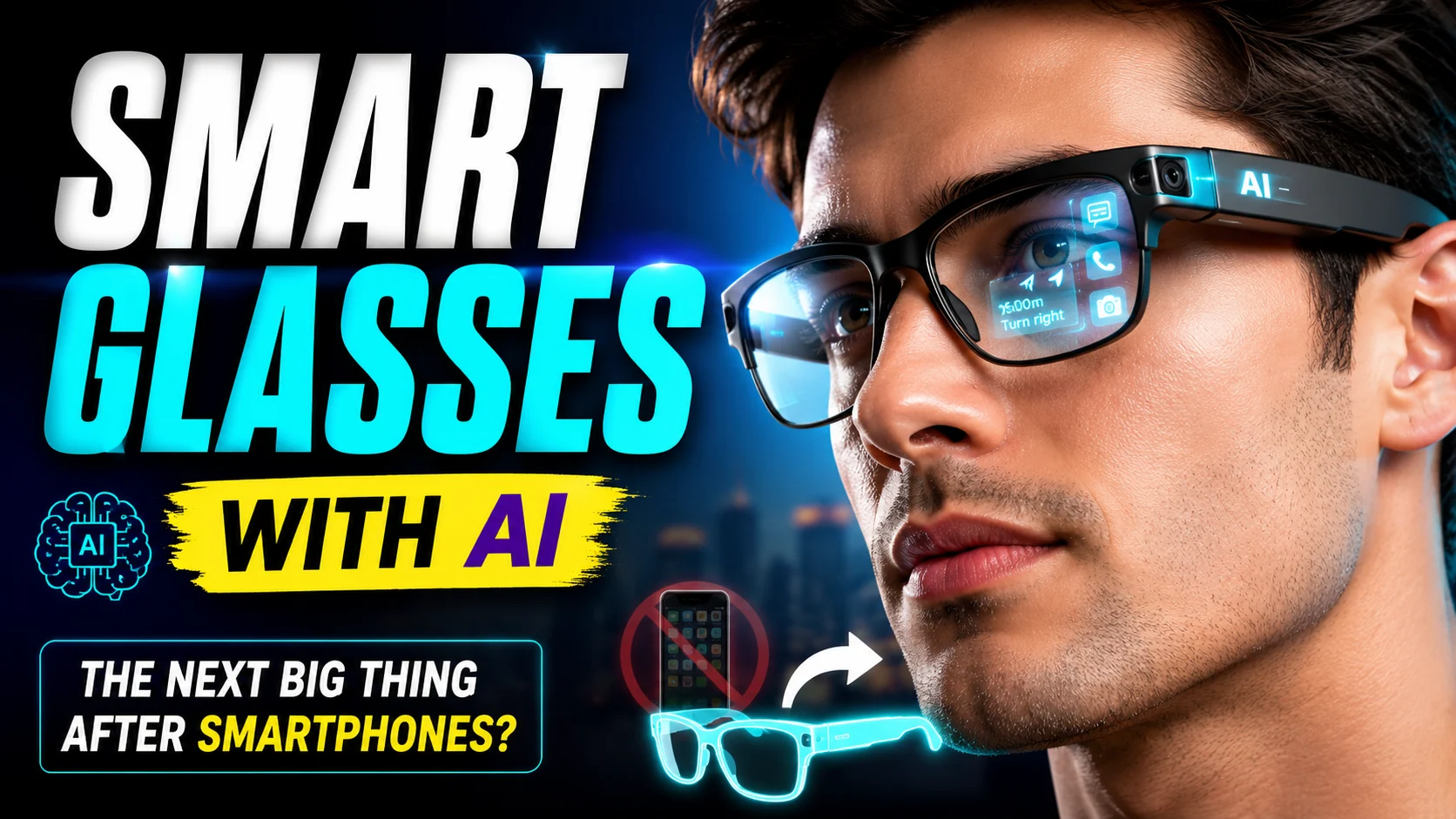
The average person spends hours each day staring down at a glowing screen, disconnected from the world around them. But what if your digital life didn’t require you to look down at all? Driven by the explosive power of generative AI, smart glasses are quietly evolving from a niche tech novelty into the wearable revolution that could eventually make your smartphone obsolete.
The Shift from Gimmick to Daily Driver
For years, the idea of smart glasses felt like a futuristic gimmick. Early iterations were clunky, awkward, and heavily focused on complex augmented reality (AR) overlays that few people actually needed. Today, the approach has fundamentally shifted. Tech giants have realized that consumers don’t necessarily want a computer monitor strapped to their face; they want a seamless, hands-free assistant.
This pivot is already paying off. The global smart glasses market saw a staggering 110% year-over-year growth in the first half of 2025, fueled heavily by the runaway success of Ray-Ban Meta AI glasses. Meta partnered with eyewear giant EssilorLuxottica to create glasses that actually look like classic Ray-Bans, blending iconic style with invisible technology.
How Multimodal AI Changed the Game
The true catalyst for this wearable revolution isn’t just miniaturized cameras or built-in speakers—it is multimodal generative AI.
Unlike older digital assistants that relied strictly on simple voice commands, today’s AI smart glasses can see and hear exactly what you do.Equipped with neural processor units (NPUs), these devices process complex multimodal inputs in real time.
- Visual Search: Look at a landmark, a foreign menu, or a pair of shoes you like, and simply ask your glasses what you are looking at. The AI analyzes the image and responds instantly.
- Live Translation:AI glasses can listen to someone speaking a different language and translate their words directly into your ear in real time.
- Contextual Assistance: Pull a shirt from your closet and ask your glasses what pants match best. The AI sees the shirt and offers personalized fashion advice.
By processing this data locally or through a quick connection to the smartphone in your pocket, AI glasses provide lightning-fast responses while keeping your data private.
Beyond Consumers: The Industrial Impact
While the consumer market grabs the headlines, AI smart glasses are quietly revolutionizing the enterprise and industrial sectors. North America currently dominates the market share, largely driven by strong enterprise adoption in logistics, healthcare, and manufacturing.
- Healthcare:Surgeons and medical professionals are utilizing AI smart glasses to easily access critical patient information without taking their eyes off the procedure.
- Logistics & Delivery:Companies like Amazon have tested AI-powered glasses for their delivery drivers.These devices offer turn-by-turn navigation, enhance package tracking, and streamline “last mile” deliveries without requiring the driver to constantly check a handheld scanner.
- Field Operations:For engineers and technicians, voice-activated smart glasses provide instant access to schematics and remote expert assistance while keeping their hands free to perform complex repairs.
The Numbers Speak for Themselves
This isn’t just hype; the market data underscores a massive shift in consumer electronics.
- The global AI smart glasses market is estimated to reach USD 2.68 billion in 2026, growing at a steady CAGR of over 8.5%.
- In the first half of 2025 alone, AI-powered models accounted for a massive 78% of all smart glasses shipments worldwide.
- Beyond Meta, industry heavyweights are racing to capture the market. Google recently confirmed that its Android XR platform will power a new line of intelligent eyewear integrated with Gemini AI, partnering with brands like Warby Parker.
The Privacy Dilemma and Roadblocks Ahead
Despite the rapid adoption, the journey to mainstream ubiquity isn’t without hurdles. Privacy remains the most significant concern. Walking around with a constantly active camera and microphone raises valid questions about consent and surveillance. Manufacturers are currently relying on LED indicator lights to signal when the device is recording, but broader public acceptance will take time.
Furthermore, high production costs limit widespread accessibility, keeping some models out of reach for the average consumer.Balancing lightweight design, battery life, and powerful AI processing remains an expensive engineering challenge that drives up prices.
Will They Replace Your Smartphone?
While AI smart glasses won’t kill the smartphone overnight, they are drastically reducing our reliance on them. Every time you leave your phone in your pocket to snap a hands-free photo, dictate a text message, or ask for walking directions, the smartphone loses a fraction of its utility.
The transition is happening gradually. Right now, smart glasses act as an extension of your phone. However, as battery technology improves and components become even more energy-efficient, the tether to the smartphone will inevitably be cut.
The Takeaway: Technology is at its best when it enhances reality rather than distracting from it. AI smart glasses represent a profound shift in how we interact with the digital world—moving away from screen-locked isolation toward ambient, invisible computing.
Are you ready to trade your screen time for a pair of AI smart glasses, or does the idea of wearable AI still feel too intrusive? Let us know in the comments below, and share this article with the tech enthusiasts in your network!
Also Read The AI Camera Feature That’s Making DSLRs Obsolete