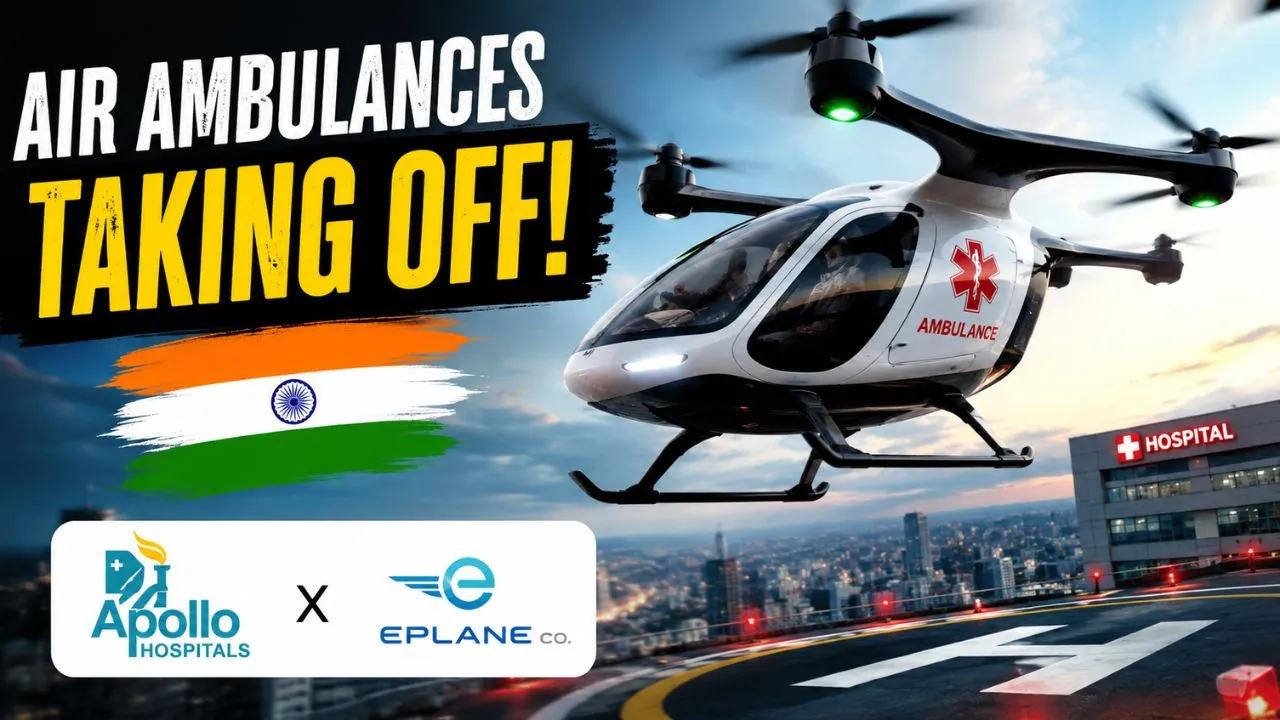
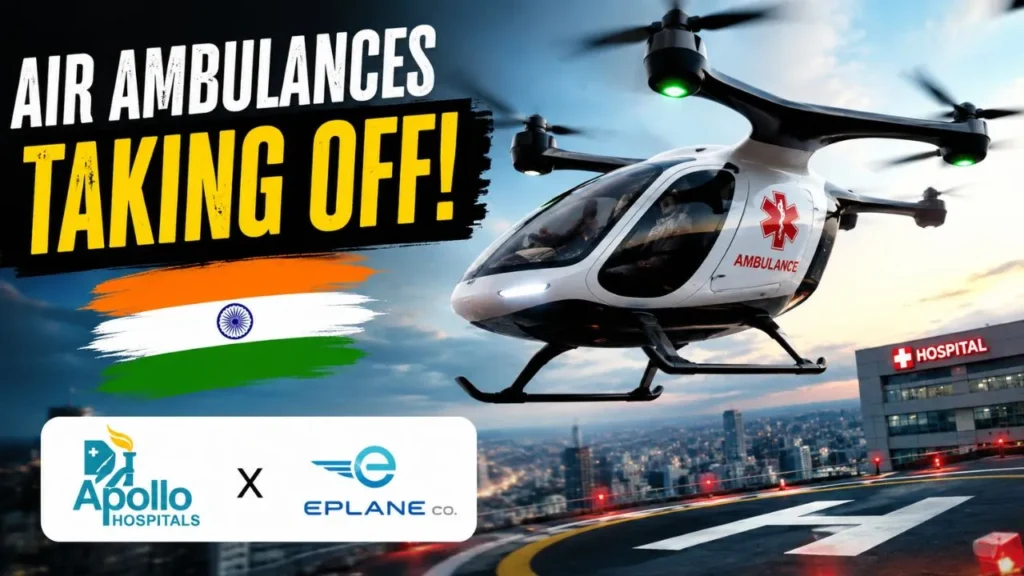
In life-threatening emergencies, every minute lost in gridlocked urban traffic can mean the difference between survival and tragedy. Bypassing India’s notoriously congested roadways, healthcare giant Apollo Hospitals Enterprise Ltd. has signed a Memorandum of Understanding (MoU) with Chennai-based aerospace startup The ePlane Company to introduce electric air ambulances and medical delivery drones into the country’s emergency healthcare system.
Announced at the Farnborough International Airshow in the UK, the partnership brings together cutting-edge electric vertical takeoff and landing (eVTOL) technology and India’s largest private healthcare network.
Reimagining Emergency Care for the ‘Golden Hour’
India faces a severe emergency response challenge. According to the Ministry of Road Transport and Highways, the country records over 170,000 traffic fatalities annually, with only one in five trauma victims reaching definitive clinical care within the critical “golden hour”—the first 60 minutes after severe injury when prompt medical intervention dramatically boosts survival rates.
The partnership directly addresses these transport bottlenecks by deploying zero-emission aerial vehicles capable of flying patients over traffic directly to hospital helipads or designated landing zones.
“India loses far too many lives simply because help cannot arrive in time,” said Dr. Prathap C. Reddy, Chairman of Apollo Hospitals Group. “I have long believed that access, along with deep clinical expertise, is what saves lives.”
Dual Aerial Strategy: Patient Air Taxis and Supply Drones
The collaboration outlines a two-pronged approach leveraging ePlane’s proprietary electric aviation tech alongside its specialized subsidiaries:
- e200X Electric Air Ambulances: The ePlane e200X eVTOL aircraft is designed to transport critical patients, organ transplants, and trauma teams up to seven times faster than road ambulances. Importantly, operating costs are expected to be a fraction of traditional multi-engine helicopters, which currently cost between ₹1.6 lakh and ₹2 lakh per hour.
- Amber Wings Medical Drones: Operating under ePlane’s drone subsidiary, unmanned aerial vehicles will handle swift point-to-point transit of blood products, vaccines, essential medicines, donor organs, and diagnostic samples—slashing delivery times across urban centers from hours to minutes.
Integrating a Nationwide Healthcare Grid
Incubated at the Indian Institute of Technology (IIT) Madras Incubation Cell in 2019, The ePlane Company (Ubifly Technologies) gains access to Apollo’s extensive distribution footprint. Apollo’s network includes over 1,066 ground ambulances, hospital campuses, emergency centers, diagnostic labs, and retail pharmacies covering nearly 18,000 postal codes across India.
“Working with Apollo Hospitals allows us to explore how our electric aircraft and drones can help close the gap between an accident and treatment,” noted Satya Chakravarthy, Founder and CTO of The ePlane Company.
As part of the initial MoU, Apollo Hospitals has indicated its intent to evaluate procurement orders for the e200X air ambulances and Amber Wings drone fleets. The agreement also leaves the door open for a strategic equity investment by Apollo into the aerospace startup as regulatory milestones are met.
Technical and Regulatory Roadmap Ahead
While the vision is transformative, several operational and regulatory steps remain before electric air ambulances become a routine sight above Indian cities.
The companies are actively coordinating with India’s civil aviation regulator, the Directorate General of Civil Aviation (DGCA), to navigate airworthiness standards, type certifications, and Beyond-Visual-Line-of-Sight (BVLOS) flight corridors. Full commercial aviation certification for the e200X prototype is targeted for early 2027.
In addition, establishing vertiport landing infrastructure, rooftop charging grids at major trauma centers, and air traffic control integration will require significant capital and urban planning cooperation.
The Takeaway for Readers
The collaboration between Apollo Hospitals and ePlane Co marks a decisive step toward the commercialization of Advanced Air Mobility (AAM) in developing nations. By prioritizing high-impact emergency medical care over luxury urban passenger travel, India could pioneer one of the world’s first widespread electric aerial ambulance networks.
For citizens and policymakers alike, supporting policies that enable drone corridors, urban vertiports, and modernized emergency aviation frameworks will be crucial. Keeping track of these technological shifts isn’t just about admiring futuristic aviation—it is about demanding infrastructure that saves lives when every second counts.
ALSO READ The 50-Million Backlog: Is India’s Justice System Built Only for the Rich?
From Food Delivery to Brain Tech: Deepinder Goyal’s Neurotech Wearable ‘Temple’ Raises $54 Million