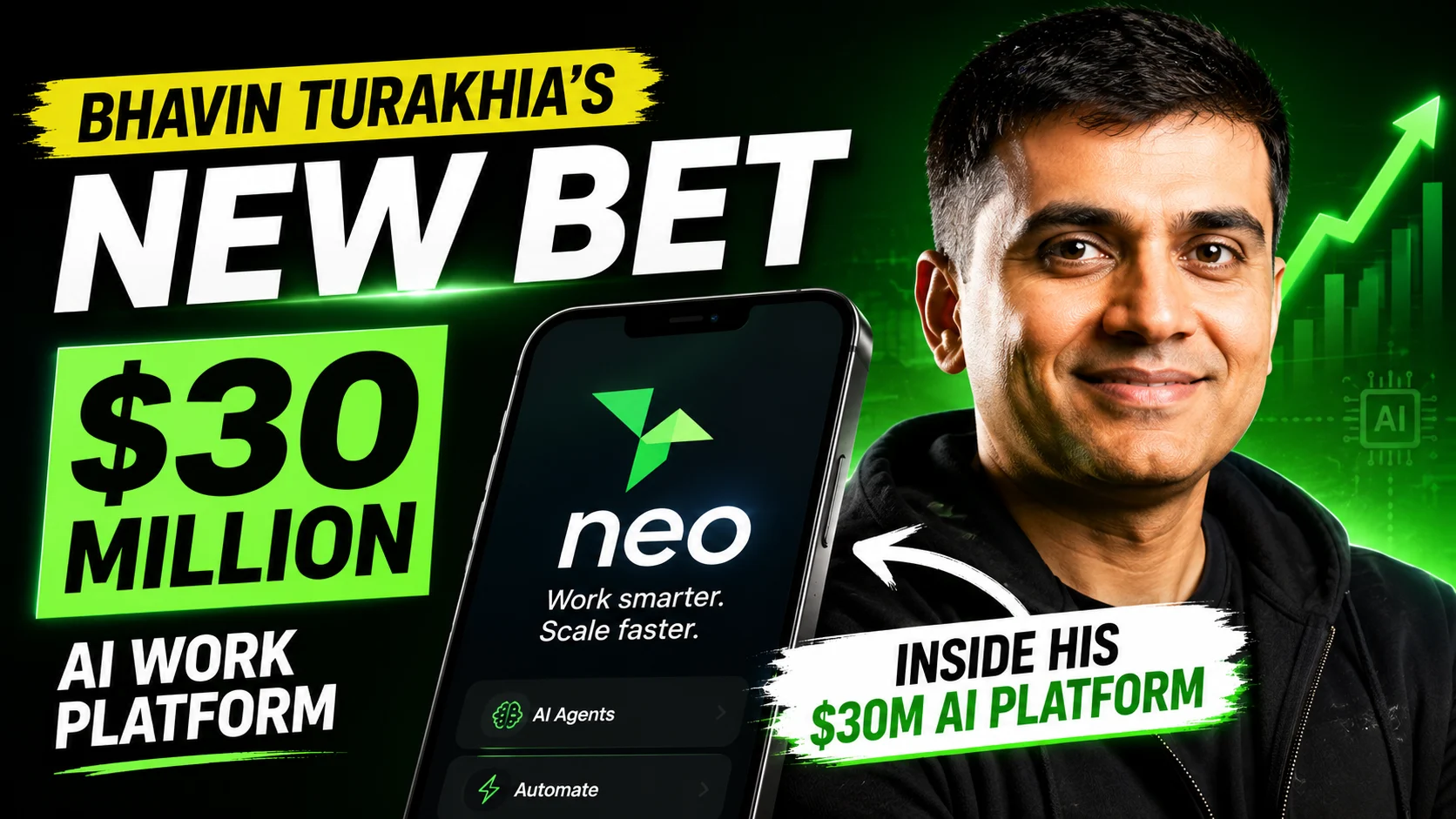
Serial tech entrepreneur Bhavin Turakhia is placing a massive $30 million wager of his own money on his latest venture, ‘Neo’—an AI-native enterprise platform designed to upend modern office productivity. Instead of merely layering artificial intelligence over outdated legacy software, Turakhia is building a unified ecosystem from the ground up, seamlessly blending human workflows with autonomous AI agents. This marks the fifth—and potentially most ambitious—personal bet for the visionary behind highly successful tech ventures like Zeta, Titan, Radix, and Directi.
A $30 Million Wager on AI-Native Productivity
For over two decades, Bhavin Turakhia has possessed a Midas touch in the global technology landscape. From the $160 million acquisition of Directi in 2014 to scaling fintech unicorn Zeta to a staggering $2 billion valuation, his track record is formidable. However, Neo represents a distinct, high-stakes pivot.
By investing $30 million entirely from his personal capital, Turakhia is signaling a profound, long-term conviction in the future of enterprise software. While most modern startups rely heavily on institutional venture capital from day one, Turakhia’s self-funded approach gives him the unbridled freedom to build the exact product he envisions. According to Turakhia, Neo was born to address a critical friction point: despite massive investments in AI, enterprises still struggle to translate that spending into measurable, real-world productivity gains due to fragmented workflows.
What is Neo? The “Operating System” for the AI Era
At its core, Neo is engineered to solve the fragmentation of workplace tools and scattered data. Today’s digital workplace is notoriously cluttered. Employees lose countless hours switching between various messaging apps, document suites, and isolated AI chatbots.
“Most organisations fail to capture the value of AI because context is fragmented, knowledge is scattered across teams, and tools remain disconnected,” Turakhia explained during the platform’s launch. “Neo changes that by centralising context and making AI a first-class participant in every workflow, not a tab beside it”.
Instead of treating AI as an isolated entity where employees must input prompts to retrieve data, Neo treats it as a collaborative coworker. It brings project tracking, document editing, and file storage under one roof, ensuring that AI agents have the full context of the company’s operations to execute tasks independently.
Breaking Down Neo’s Ecosystem
The Neo workspace is designed as an integrated suite, featuring distinct, deeply connected tools that work in harmony to reduce context switching:
- Friday: Serving as the brain of the platform, Friday is an advanced AI assistant and agent layer that connects to more than 1,000 external business applications.
- Tasket: A robust, intelligent project management tool designed to streamline task execution and delegation.
- Studio: A next-generation knowledge management workspace that natively supports dynamic documents, complex spreadsheets, and intricate diagrams.
- Drive: A collaborative file-sharing environment where human employees and AI agents can co-author, analyze, and manage files simultaneously.
By unifying these tools, Neo effectively eliminates the barriers that drain workplace efficiency, creating a streamlined digital environment tailored initially for mid-market and knowledge-based businesses.
Beyond the Chatbot: Why Legacy Tools Are Failing
Neo is stepping into one of the world’s most competitive software arenas, challenging established productivity giants like Microsoft Office, Google Workspace, and Notion. However, Turakhia’s core thesis is simple: the next generation of enterprise software cannot be built by merely slapping AI features onto decade-old products.
Currently, many organizations layer basic AI assistants over legacy software. Turakhia argues this approach is fundamentally flawed because the context remains broken. When knowledge is trapped in one person’s head or locked inside a disconnected application, an AI tool cannot function optimally. Neo’s architecture fundamentally rethinks this, bringing work execution, institutional knowledge, and AI collaboration into a single, unified data fabric.
The Road Ahead: A New Frontier for Enterprise AI
Developed in just three months by a lean, highly skilled team of 18 engineers, Neo is poised to redefine how businesses operate. The platform is slated to enter a closed beta testing phase between August and September, with a broader public launch anticipated in the first quarter of next year.
The Takeaway:
Bhavin Turakhia’s $30 million bet on Neo is a massive wake-up call to the enterprise software industry. It proves that the future of work isn’t about simply giving employees a smarter chatbot—it’s about completely redesigning the digital workplace so that AI and humans can truly work side by side. For business leaders and founders, the message is clear: to survive the impending AI revolution, you must fundamentally rethink how work gets done. Prepare to integrate AI directly into your core business workflows, or risk being left behind by those who already have.
Also Read Neo Group Raises ₹350 Crore: Inside India’s Wealth-Tech Boom