In 1985, Douglas Adams’ The Hitchhiker’s Guide to the Galaxy introduced the world to the “Babel fish”—a tiny, leech-like creature you shoved into your ear to instantly understand any language in the universe. For decades, it remained the ultimate science-fiction fantasy. Fast forward to 2026, and that fantasy is sitting comfortably in our ears.
Imagine walking into a bustling bakery in Lisbon, asking for a pastry in English, and hearing the cashier’s Portuguese response translated directly into your ear just seconds later. No frantic typing into an app, no awkward hand gestures—just a seamless, natural conversation. Powered by Large Language Models (LLMs) and advanced neural mapping, AI translation earbuds are rapidly turning the globe into a single, cohesive neighborhood.
Here is a look at how this groundbreaking wearable tech actually works, where it excels, and what to know before you ditch your pocket phrasebook.
From Sci-Fi to Science Fact: What Are Translation Earbuds?
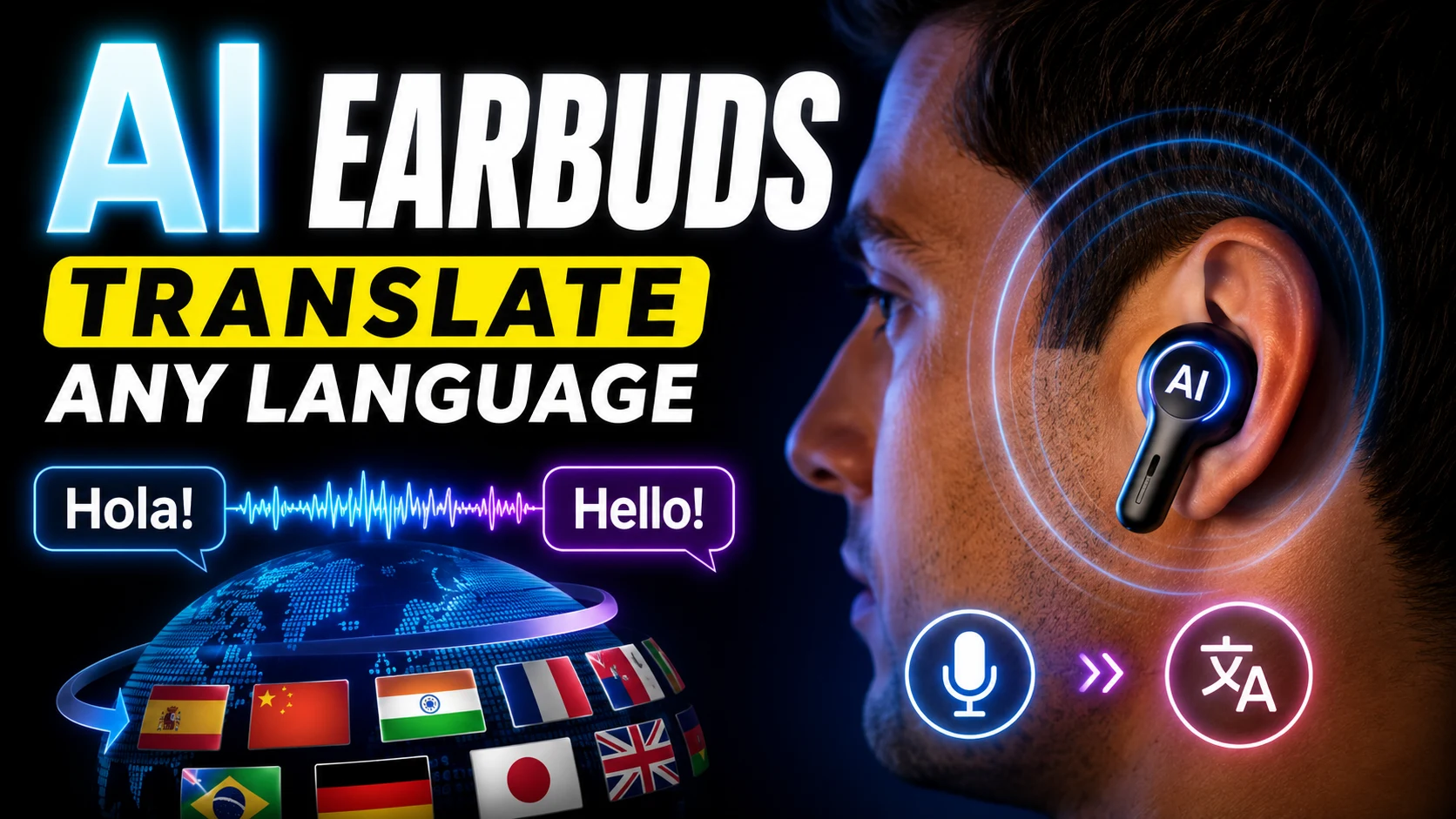
At first glance, AI translator buds look identical to your standard wireless audio gear. But beneath the sleek exterior lies a highly sophisticated hardware-software ecosystem. These aren’t just broadcasting audio; they are capturing, transmitting, translating, and synthesizing human speech in real time.
Industry leaders like Timekettle and prominent tech giants have pioneered systems that pair specialized earbuds with a smartphone app or a localized edge-computing chip. While your phone or the cloud does the heavy lifting, the earbuds serve as the critical bridge, ensuring voices are captured crisply and delivered naturally.
The Four-Step Magic: Inside the Tech
When you speak, the system executes a complex, four-step digital relay race in a matter of seconds:
- 1. Precision Voice Capture: Street traffic and cafe chatter are the enemies of translation. Modern earbuds utilize beamforming directional microphones and AI noise filtering to isolate human speech.Advanced models, like Timekettle’s W4 series, even use bone-voiceprint sensors to capture the physical vibrations of your jaw, ensuring a pure audio signal regardless of background noise.
- 2. Automatic Speech Recognition (ASR): The isolated audio is converted into digital text. Today’s ASR doesn’t just transcribe words; it analyzes accents, dialects, and grammatical patterns to understand intent, even if the speaker mumbles or stumbles.
- 3. Neural Machine Translation (NMT): The text hits a translation engine. Instead of robotic, word-for-word translations, modern AI assesses context.Some systems now feature a “State of the Art Translation Engine Selector,” which dynamically chooses the best Large Language Model (LLM) for the specific language pair being spoken, ensuring regional nuances aren’t lost.
- 4. Text-to-Speech (TTS) Synthesis:Finally, the translated text is converted back into an audio waveform.High-end devices now utilize emotional TTS, mimicking natural human intonation and rhythm so the output doesn’t sound like an automated customer service bot.
Unlocking Travel and Global Business
For tourists, the appeal is obvious. Navigating a Tokyo subway station or negotiating at a market in Peru becomes significantly less stressful when the language barrier evaporates. The earbuds allow travelers to maintain eye contact and engage in cultural exchange rather than staring down at a screen.
But the real revolution is happening in the business sector. Professionals managing international supply chains or global clients are using premium devices to conduct two-way simultaneous translations during online meetings or standard phone calls.In some iterations, the person on the other end of the line doesn’t even need to own the hardware to experience the real-time translation.
The Reality Check: Latency and Limitations
Despite the incredible advancements, the tech still abides by the laws of physics and connectivity.
- The Latency Factor: “Real-time” doesn’t mean instant. Because the data often has to travel to a cloud server and back, users can expect a 1 to 3-second delay. Conversations require a slight rhythm adjustment—waiting for the translation to finish before replying.
- Internet Dependence:Cloud-based processing requires a stable data connection.While offline language packs are becoming more common—powered by edge AI models—they can sometimes lack the deep contextual accuracy of their cloud-based counterparts.
- Environmental Challenges:While bone-conduction tech helps, heavy wind or extremely loud environments can still confuse the microphones, causing transcription errors.
The Takeaway
We are witnessing the end of the language barrier. While AI translation earbuds may still have a slight learning curve regarding conversation pacing, the technology has officially crossed the threshold from a novelty gadget to a highly practical communication tool.
Next steps for the modern traveler: The next time you pack your passport for an international adventure or prep for a cross-border business deal, leave the heavy translation dictionaries behind. A pair of AI earbuds might just be the most important travel companion you can bring.
Also Read The AI Camera Feature That’s Making DSLRs Obsolete