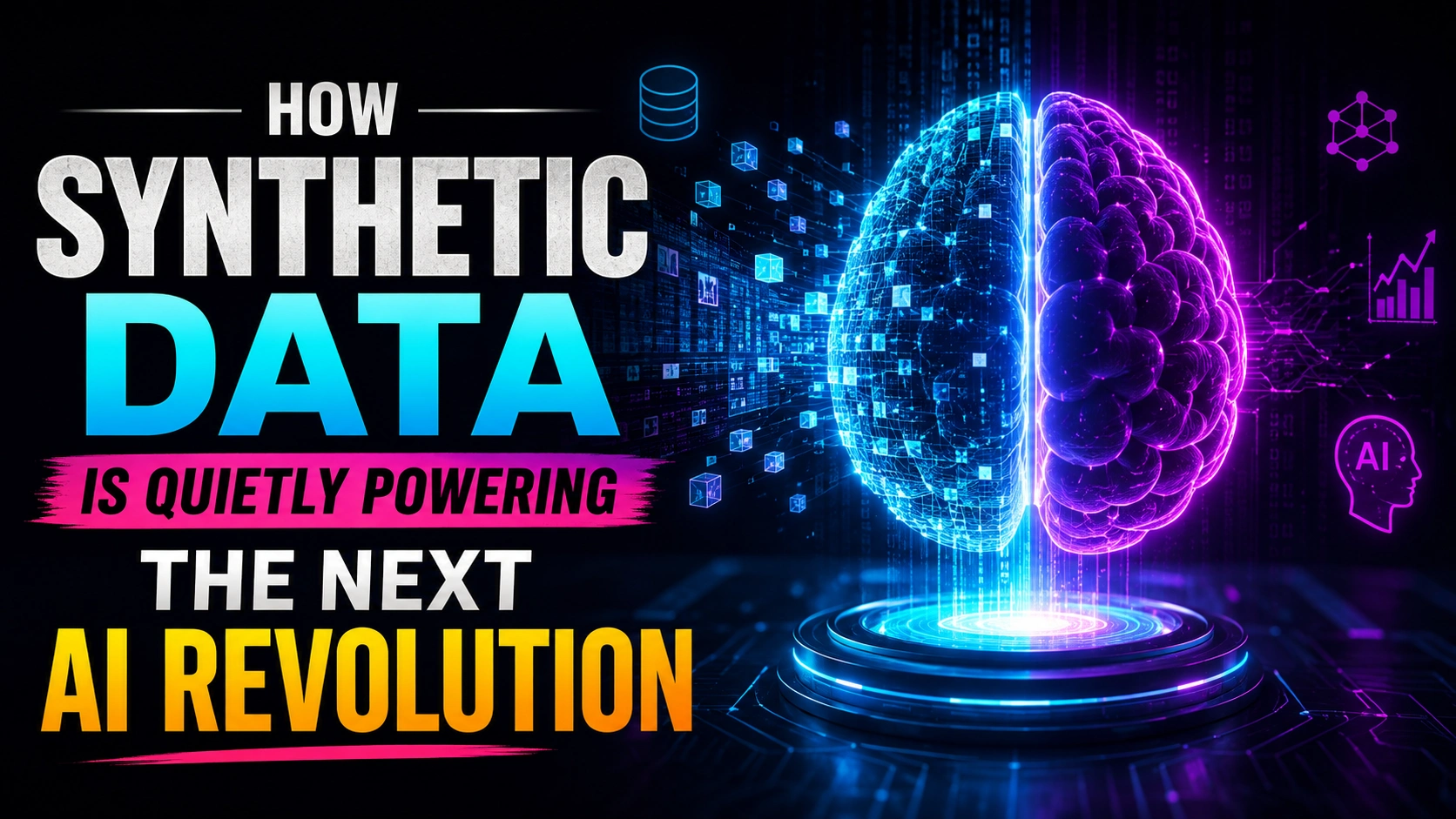
The internet’s training data is practically exhausted. After scraping billions of websites, books, and images, artificial intelligence models are running out of high-quality, human-generated information to consume. But instead of starving, AI has found a new, infinite fuel source: itself.
Welcome to the era of synthetic data—a breakthrough technology where algorithms generate their own simulated worlds to learn faster, safer, and cheaper than ever before.
While the public fixates on the latest consumer chatbot updates, tech giants and enterprise leaders are quietly pivoting their underlying infrastructure. They are no longer just collecting data; they are manufacturing it.
The Exhausted Internet: Why Real Data Is No Longer Enough
For the past decade, the foundational AI playbook was simple: scrape the web, label the data, and train the model. But this brute-force approach has hit a massive wall.
First, the sheer volume of pristine, human-generated data is finite. Second, real-world data is inherently messy, incredibly expensive to label, riddled with human biases, and increasingly locked behind strict privacy walls like GDPR and HIPAA.
To build smarter, more capable AI systems, developers desperately need a new strategy. Enter synthetic data—artificially generated datasets that mirror the exact statistical patterns of real-world information, but contain no actual human fingerprints.
What Is Synthetic Data, Exactly?
Simply put, synthetic data is computer-generated information that behaves exactly like the real thing.Instead of relying on tedious user surveys, IoT sensors, or web scrapers, companies use simulations, mathematical models, and generative AI networks to produce “digital twins” of reality.
These aren’t just deepfakes or random digital noise. They are mathematically rigorous, fit-for-purpose datasets engineered for precision and scale.
Edge Cases and Privacy: The Real-World Superpowers of “Fake” Data
Why are companies heavily investing in synthetic data generation platforms? Because it fundamentally solves the two biggest bottlenecks in modern AI development: privacy compliance and “edge case” training.
- The Autonomous Vehicle Dilemma: How do you safely train a self-driving car to react to a child darting into a snowy street at midnight? You cannot ethically orchestrate that in the real world. Instead, simulators generate millions of rare, dangerous, and complex scenarios, allowing AI to learn how to react without putting a single human at risk.
- The Healthcare Catch-22:Medical researchers urgently need vast amounts of data to train AI diagnostic tools, but patient records are heavily protected by privacy laws.By generating synthetic medical records—which maintain the exact statistical properties of real diseases but belong to “ghost” patients—hospitals can innovate without compromising confidentiality.
- Banking and Fraud Detection: Financial institutions can generate synthetic transactional histories to train complex fraud detection algorithms. This allows them to build more secure systems without ever exposing sensitive customer account details to their engineering teams or third-party vendors.
- The “David vs. Goliath” Play: More data doesn’t always equal better AI. Microsoft proved this with its Phi-1 model. Instead of feeding it the entire unfiltered internet, they trained a much smaller model on highly curated, “textbook-quality” synthetic data. The result? It outperformed models ten times its size on complex coding benchmarks because the data was remarkably clean.
The $4.6 Billion Market Shift
The numbers driving this shift are staggering. The global synthetic data generation market is projected to skyrocket from roughly $736 million in 2025 to over $4.6 billion by 2032, expanding at a massive 29.9% compound annual growth rate.
Industry analysts are sounding the alarm for companies that fail to adapt. According to Gartner, a staggering 80% of all AI training will rely on synthetic data by 2028. Furthermore, Gartner projects that by 2030, synthetic data will completely overshadow real data in AI models, making traditional data harvesting largely obsolete.
The Catch: The “Model Collapse” Threat
Like any emerging technology, synthetic data isn’t a flawless magic bullet. The biggest looming threat in the industry is a phenomenon known as “Model Collapse”.
Recent research from Oxford University highlighted that when AI models are recursively trained entirely on synthetic data without any human baselines, they can begin to degrade.Over multiple generations, the AI amplifies its own systemic biases and gradually “forgets” rare edge cases, resulting in a model that confidently produces generic or inaccurate garbage.
To prevent this collapse, industry leaders are not replacing real data entirely. Instead, they are utilizing synthetic data strictly as an augmentation tool—mixing it with high-quality real data as an anchor, and applying rigorous verification loops to ensure outputs remain grounded in reality.
The Bottom Line: Adapt or Be Left Behind
We are currently witnessing a fundamental shift in how artificial intelligence is constructed. The organizations winning the AI race today are the ones building proprietary synthetic data pipelines that their competitors simply cannot replicate.
The Takeaway: If your company’s AI strategy still relies purely on manual data collection and web scraping, you are already burning cash and falling behind the curve. Start small: identify one specific operational bottleneck where real data is too expensive, scarce, or legally risky to acquire. Use synthetic data to bridge that gap safely. The future of artificial intelligence isn’t just about learning from the real world—it is about learning from the meticulously engineered worlds we build for it.
Also Read How AI Is Quietly Running Your City’s Traffic Lights—And Saving You Hours of Commuting