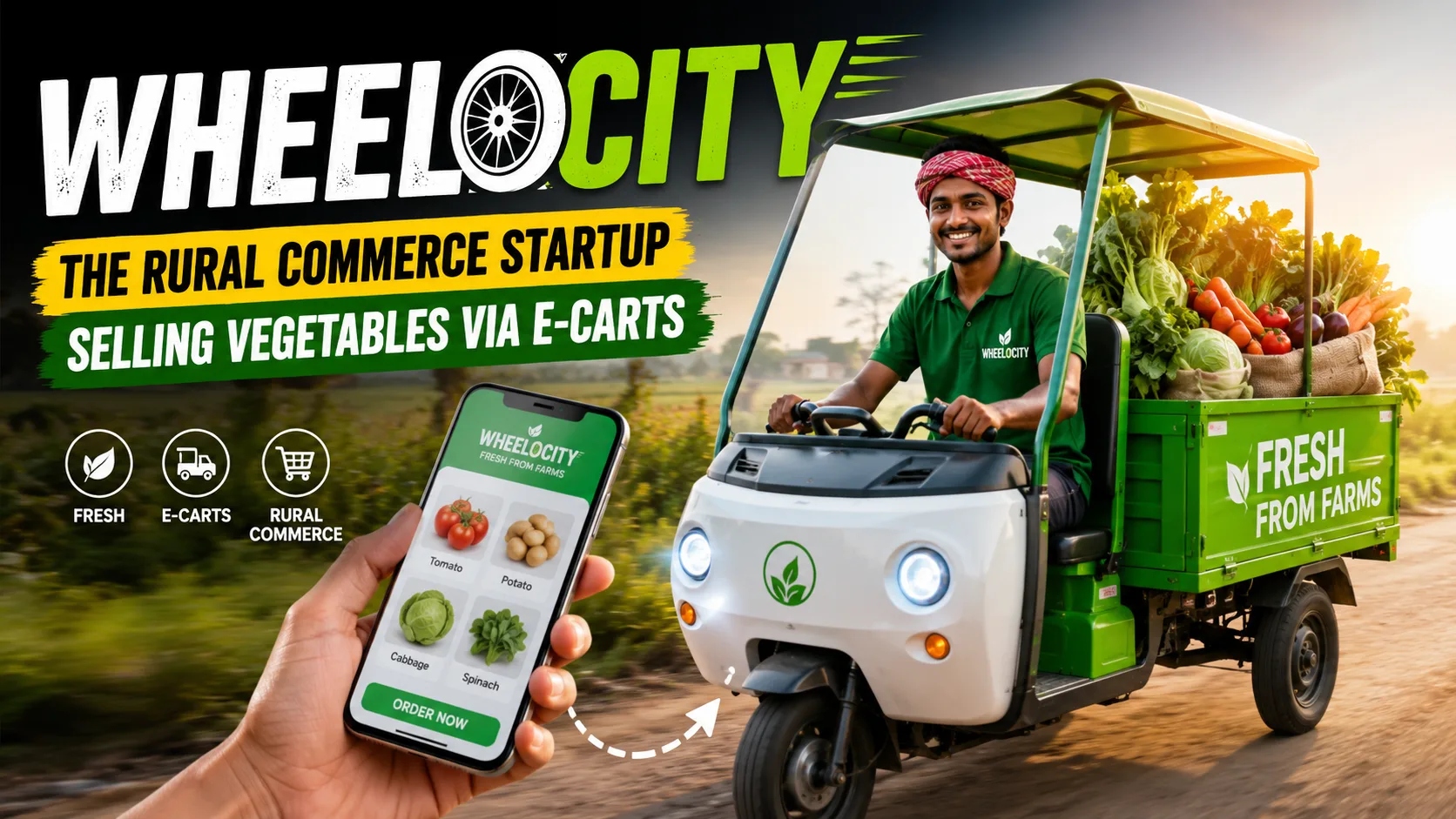
Imagine a market of over 800 million consumers, living in the heart of rural India, systematically bypassed by the modern e-commerce boom. Now, picture a silent, electrified fleet of e-carts navigating these remote villages, delivering farm-fresh produce directly to household doorsteps every single day. This is the reality being engineered by Wheelocity, a fast-growing rural commerce startup that is successfully transforming the agricultural supply chain in the country.
The Great Access Problem in ‘Bharat’
For decades, rural India—often referred to as ‘Bharat’—has struggled with a deeply fragmented and inefficient supply chain. While urban consumers enjoy 10-minute grocery deliveries, rural citizens face a starkly different reality. High transportation costs, a lack of cold-chain infrastructure, and a complex web of intermediaries have historically resulted in two major crises: exorbitant consumer prices and massive food wastage.
Recognizing that brands find it costly to serve these remote markets due to scattered demand, Wheelocity set out to build the “access rails” for rural commerce. By establishing high-frequency daily delivery routes starting with fruits and vegetables, the startup is solving the fundamental problem of accessibility for rural households while introducing transparency to a notoriously opaque sector.
The Pivot That Sparked a Supply Chain Revolution
Founded by Selvam VMS, Amresh Singh, and Senthil Kumar, Wheelocity originally launched as an urban B2B supply chain network. The founders were on a mission to minimize food wastage—a critical driver of malnutrition in India.
However, after months of intense fieldwork, the team experienced an “aha” moment in April 2023. They realized that the true gap in the market wasn’t in the cities, but in the villages. This led to a strategic pivot from an urban B2B logistics model to a rural B2C commerce platform.
They launched “Wheelocity on Wheels” (WOW), a fresh commerce pilot program that introduced India’s first flowthrough “Pitstop” model and a gig delivery network tailored specifically for rural geographies. The consumer response was immediate, turning a bold experiment into a highly scalable business model that processes massive volumes of fresh food daily.
Tech Meets Tradition: How the E-Cart Model Works
To make daily rural deliveries profitable and sustainable, Wheelocity relies on a “phygital” (physical plus digital) approach, merging advanced supply chain software with on-the-ground hardware. Here is how their technology-driven ecosystem operates:
- Electrified Gig Fleet: Wheelocity utilizes a fleet of custom-designed e-carts that currently log over 100,000 kilometers every single day. This zero-emission approach cuts down on carbon footprints while significantly reducing last-mile logistics costs.
- Predictive AI & Smart Forecasting: Through deep data models, the platform anticipates consumer demand in specific villages, preventing overstocking and reducing spoilage. Today, the startup successfully avoids over 50,000 kilograms of fruit and vegetable wastage daily.
- Location Intelligence: Advanced algorithms optimize distribution routes in real-time, ensuring that perishable goods reach consumers at peak freshness.
- IoT Integration: Internet of Things (IoT) sensors monitor the supply chain constantly, bringing unprecedented operational efficiency and real-time tracking to rural deliveries.
Empowering Rural Economies and Attracting Investors
Wheelocity’s impact extends far beyond convenient grocery deliveries; the startup functions as a localized economic engine. By integrating rural youth into the gig economy as channel partners, Wheelocity has created over 2,000 employment opportunities and enhanced the quality of life for over one million households.
This hyper-localized, scalable approach has caught the attention of major venture capitalists. Backed by prominent institutional investors like Lightspeed Venture Partners and Anicut Capital, Wheelocity has raised a total of $27 million across multiple funding rounds. Most recently, in July 2026, the company secured an ₹82 crore Series A funding round, empowering them to rapidly scale their e-cart network and technology stack across the country.
What’s Next for Wheelocity?
Fruits and vegetables are just the entry point. By successfully establishing a reliable, high-frequency supply chain for highly perishable items, Wheelocity is actively laying the groundwork required to transport any product into the rural heartland.
In the near future, the startup plans to leverage these established “access rails” to introduce Fast-Moving Consumer Goods (FMCG), electronics, and other essential services to its rural customer base, unlocking an untapped market worth billions.
The rural Indian market is no longer a distant frontier; it is the next epicentre of e-commerce growth. Wheelocity has proven that with the right mix of technology, sustainable mobility, and local empowerment, connecting with Bharat is not only possible but highly profitable.
Are you keeping an eye on the startups reshaping our economy? As the line between urban convenience and rural accessibility continues to blur, the agritech and logistics sectors are primed for massive disruption. Share this article with your network and subscribe to our daily newsletter to stay updated on the latest breakthroughs in tech, startups, and rural commerce!
Also Read Swish Lands $38M Series B: How a Bengaluru Startup is Winning the 10-Minute Food Delivery War