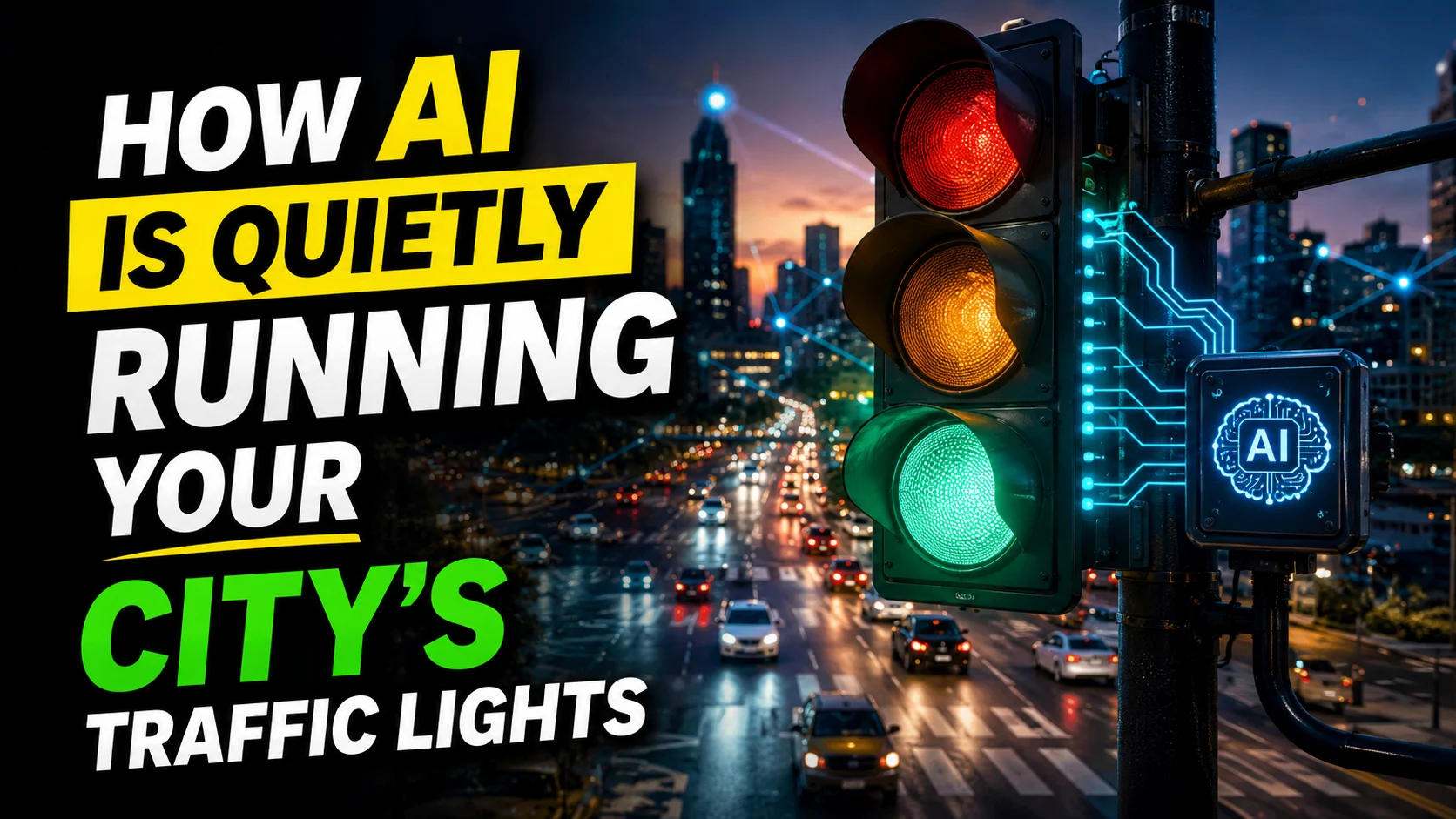
Have you ever braced yourself for a notoriously long red light, only to find it magically turn green just as you approach? You aren’t just getting lucky; you are likely being guided by an invisible, highly intelligent co-pilot. From Bengaluru to Boston, artificial intelligence is quietly taking over city intersections, replacing decades-old pre-programmed timers with dynamic algorithms that learn, adapt, and predict.
For decades, urban mobility has been governed by “dumb” infrastructure. Traditional traffic lights operate on rigid, fixed-time cycles or rely on physical magnetic loops buried under the asphalt that merely count the cars passing directly over them. If you’ve ever sat at a red light at 2:00 AM with no cross-traffic in sight, you’ve experienced the limitations of this outdated system.
But the era of the static grid is coming to an end. Enter smart traffic management systems—a technological leap that uses real-time data, camera feeds, and machine learning to create a living, breathing road network.
The End of the “Dumb” Intersection
Unlike older setups, adaptive traffic signal control doesn’t just react to a car sitting at the line; it anticipates traffic flow blocks away. These AI traffic lights continuously analyze vehicle volumes, pedestrian density, and even public transit schedules.
Think of it as a video game where the AI is trained using reinforcement learning.
- The Reward: Smooth, continuous movement of vehicles and shorter wait times.
- The Penalty: Idling cars, sudden stops, and traffic jams.
By continuously adapting to these rules, the software creates “green waves”—a synchronized chain of green lights that allows groups of vehicles to travel through multiple intersections without stopping.
From Bengaluru to Boston: The Real-World Impact
This isn’t a futuristic concept sketched out on a Silicon Valley whiteboard; it is already dictating your daily commute.
In India’s tech capital, notoriously ranked among the world’s most gridlocked cities, the results have been staggering. In May 2024, the Bengaluru Traffic Police rolled out their AI-powered Adaptive Traffic Control System (BATCS) across 60 major junctions.According to official data, the system slashed travel times by up to 33% at major bottlenecks like Hudson Circle.It also increased hourly vehicle throughput by 30%, meaning thousands of extra commuters got home faster without any new roads being built. The city plans to expand this network to over 560 junctions.
Globally, tech giants are joining the fight against gridlock. Google Project Green Light is currently operating in more than 20 cities across four continents, including Kolkata, Rio de Janeiro, and Boston.Instead of asking municipalities to install expensive new hardware, Google leverages its massive trove of Google Maps driving trends to model traffic patterns and provide actionable recommendations to city engineers.
In Kolkata, Police Commissioner Vineet Kumar Goyal noted that implementing Google’s AI suggestions across 13 major intersections drastically reduced gridlock and organized traffic flow.Early global numbers from Google indicate a potential 30% reduction in stops and a 10% drop in greenhouse gas emissions at these optimized intersections.
Meanwhile, Pittsburgh has been a pioneer in this space. Partnering with Carnegie Mellon University, the city deployed an AI-regulated grid that cut time lost in traffic jams by 40% and vehicle emissions by 20%.
Why It Matters: A Climate and Safety Crisis
While getting home 10 minutes earlier is a great perk, the true value of an AI-driven traffic congestion solution lies in public health and environmental impact.
- Emission Hotspots:According to environmental data, air pollution at city intersections can be up to 29 times higher than on open roads.Half of these emissions come from cars accelerating after a dead stop. Eliminating unnecessary idling directly cuts down the carbon footprint of urban transport.
- Pedestrian Safety: AI doesn’t just prioritize cars; it protects people. In Madrid, a pioneering system analyzes video feeds from 56 cameras to recognize pedestrians and cyclists.During massive events, like matchdays at the Metropolitano stadium, the AI autonomously lengthens pedestrian crossing times when it detects large crowds.
The Future of Urban Mobility
We are rapidly approaching a reality where traffic lights won’t just respond to cars—they will communicate with them. As connected vehicles become more mainstream, your car will continuously talk to the city’s grid, allowing AI to dynamically route traffic away from accidents, clear paths for ambulances instantly, and practically eliminate the stop-and-go nightmare of rush hour.
The Takeaway: The next time you cruise through three green lights in a row during your evening commute, don’t just thank your lucky stars—thank the algorithm working quietly above you.
What does your daily commute look like? Have you noticed smoother traffic in your city recently? Share your thoughts in the comments below or tag your local city council to demand smarter, AI-driven intersections in your neighborhood!
Also Read The Rise of AI Girlfriends and Boyfriends: A Society Divided